
Why did Marine Le Pen resign from her party? It's all part of the plan
The decision was described in Le Monde as being 'a pure formality'
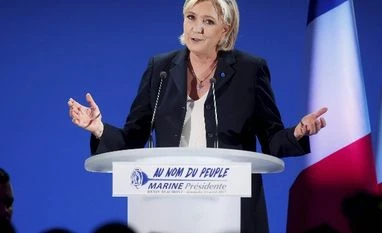 "Why did Marine Le Pen resign from her party? It's all part of the plan")
premium
WebinarsNew
Deep DiveNew
Explore Business Standard
The decision was described in Le Monde as being 'a pure formality'
In France, however, media reaction to her announcement has been more subdued and cynical. The decision was described in Le Monde as being “a pure formality” – a necessary ploy in the second phase of the electoral game.The international press has made much of Marine Le Pen’s announcement that she is standing down from the leadership of her party the National Front. Just after being selected to proceed to the second round of the French election, she explained that, for the rest of the campaign, she had to dedicate herself to rallying support from beyond her own party in order to become “President of all the French”.
Le Pen is simply seeking to appeal to voters outside the FN as a non-partisan president. The idea of such a president was initiated by Charles de Gaulle when he oversaw the creation of the Fifth Republic in 1958. He despised the political parties, accusing them of being responsible for creating the vacuum of political power that triggered the collapse of the Fourth Republic. He liked to present himself as being “above” the political parties, and his constitution ascribes the president with the role of “arbitrating” the political “mélée”.
By standing down now, Le Pen can present herself as “the candidate of the people” in true Gaullist tradition, against her opponent, the candidate of “the system”.
But the idea of the non-partisan president is a fiction. Even de Gaulle needed a party to help him win elections and to build parliamentary support. Likewise, Le Pen’s move is, in reality, purely symbolic. Her party will not meet in any formal way until after the campaign anyway, and her personal authority is such that her leadership position simply remains “on hold” until after the second round.
After the final result, if she loses, Le Pen will simply take back the formal leadership. If she wins, she will hand it over as she turns her attention to the presidential office.
Short-term strategy
In 2002, Le Pen’s father Jean-Marie Le Pen, rejected a suggestion from his close party advisers (including Marine) that he might temporarily stand down until after the second round, but the situation was different. Back then, he had no real expectation of winning. His daughter, however, aims to govern, and to do so, she knows she needs to reach beyond the party faithful.
Support for the second round vote could transfer to Le Pen from several different candidates, right or left. On the right, a fair share of socially conservative Fillon supporters will no doubt opt for her, as will many of the 4.7% who voted for Nicolas Dupont-Aignan, whose programme is close to Le Pen’s on many issues such as immigration and Europe. But she will probably also gather some support on the left from voters for Jean-Luc Mélenchon, who has similar policies with regard to the EU, and in many ways also speaks to those who feel left behind by globalisation and europeanisation.
In fact, the main cleavage to emerge in this presidential election has been the question of France’s relationship with the EU, and the second round at least has the virtue of clarifying a stark choice between withdrawal from the euro, leading ultimately to Frexit, and Emmanuel Macron’s europhile commitment to rebuilding and reforming the EU on the basis of a revitalised partnership with Germany and a strengthened eurozone.
The deep divisions in France have been laid bare by this election, not just between more or less Europe, but also between urban and rural populations, between the winners and losers of globalisation, between proponents of a closed or an open society, between tradition or diversity. That makes it hard to see how any candidate could seriously claim to be “president of all the French”.
Whoever wins the contest will struggle to unite a France which looks as ungovernable as ever. As de Gaulle lamented: “How can you govern a country which has 258 different types of cheese?”
Susan Collard, Senior Lecturer in French Politics & Contemporary European Studies, University of Sussex
This article was originally published on The Conversation. Read the original article.
Already subscribed? Log in
Subscribe to read the full story →

3 Months
₹300/Month
1 Year
₹225/Month
2 Years
₹162/Month
Renews automatically, cancel anytime

Premium stories handpicked daily by our editors


News, Games, Cooking, Audio, Wirecutter & The Athletic
Digital replica of our daily newspaper — with options to read, save, and share


Insights on markets, finance, politics, tech, and more delivered to your inbox
In-depth market analysis & insights with access to The Smart Investor


Repository of articles and publications dating back to 1997
Uninterrupted reading experience with no advertisements


Access Business Standard across devices — mobile, tablet, or PC, via web or app
First Published: Apr 26 2017 | 8:23 AM IST

