
Trump economic advisor Gary Cohn quits; Dow futures eye fall over trade war
White House officials said the dispute over tariffs contributed to Cohn's decision
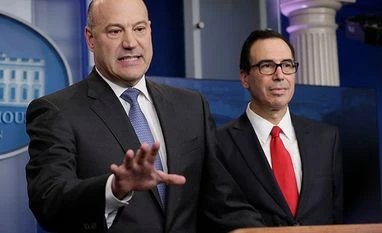 "Trump economic advisor Gary Cohn quits; Dow futures eye fall over trade war")
Explore Business Standard
White House officials said the dispute over tariffs contributed to Cohn's decision
US stock futures fell more than 1 percent late Tuesday after the resignation of US President Donald Trump's top economic adviser, Gary Cohn, fueled fears that the administration would follow through with plans to impose steel and aluminum tariffs, possibly triggering a trade war.
White House officials said the dispute over tariffs contributed to Cohn's decision to resign but was not the only reason.
S&P 500 e-mini futures
Investors said the news, which creates more uncertainty over the administration's economic agenda, will likely weigh on the market in Wednesday trading as well.
"It's a very significant deal for the markets. The markets don't like tariffs ... Gary Cohn was one of Wall Street's guys and an endorser of conventional economic policy," said Michael Purves, chief global strategist at Weeden & Co in New York.
"That is driving policy uncertainty and a path to potentially more of a populist nationalist economic agenda. The market is selling off for a good reason."
Cohn, a former president and chief operating officer of investment bank Goldman Sachs , was seen by investors as a stabilizing force within the Trump administration. Business lobbyists frequently cited Cohn as their strongest ally in the White House.
"Most stock market investors would have preferred to see him stay because he's someone who represents a fairly deep understanding of the market," said Rick Meckler, president of LibertyView Capital Management in Jersey City, New Jersey.
But he and other investors said that the effect of Cohn's resignation on the market could be short-lived, given that previous turmoil in the White House has had a limited impact on Wall Street.
During the regular session, stocks ended with a small gain after a choppy day's trading that was marked by fears of a trade war and mixed signals from Washington on whether Trump would follow through with the proposed tariffs.
Trump reiterated his plan to slap hefty import tariffs on steel and aluminum, saying "trade wars aren't so bad", even as lawmakers such as Senate Majority Leader Mitch McConnell stepped up calls to scrap the proposal.
Earlier in the day, strategists said some investors were beginning to bet Trump would not follow through on the proposal, which they saw as a negotiating tactic in trade talks. But gains were limited by the uncertainty.
Investors also watched news that North Korea was open to the possibility of talks with the United States on denuclearization.
At the close of Tuesday's session, the Dow Jones Industrial Average rose 9.36 points, or 0.04 percent, to close at 24,884.12, the S&P 500 gained 7.18 points, or 0.26 percent, to 2,728.12 and the Nasdaq Composite added 41.30 points, or 0.56 percent, to 7,372.01.
First Published: Mar 07 2018 | 8:33 AM IST


