Over the last one year, luxury car makers BMW and Mercedes have gone on the offensive with their entry-level models, with price tags labelled as low as Rs 20.90 lakh (see chart). Audi had already set its pace in the race for the top slot in the luxury market with the introduction of compact sports utility vehicle (SUV) Q3 in mid-2012. The low entry-price of the luxury car brands has meant that mass car manufacturers such as Honda, Volkswagen, Hyundai and Skoda have had to slug it out to attract buyers for their premium sedans.
While retail sales of luxury vehicles from BMW, Mercedes and Audi shot up by around 9-10 per cent to around 28,000 units in 2013 (the volumes are according to industry estimates as BMW is yet to share annual sales numbers), demand for premium sedans such as Skoda Superb, Hyundai Sonata and Volkswagen Passat have shrunk by 31 per cent to 2,974 units in the first nine months of the last calendar year. In 2012-13 too, sales in the category had dipped by 32.2 per cent to 4,358 units as per wholesale data from Society of Indian Automobile Manufacturers (SIAM).
"There has been a coupling effect. The entry-level models of luxury car makers has brought down the price differential with premium products by around 30 per cent. This has broadened the target consumer base. The luxury products enjoy strong brand pull; so, customers, initially looking at buying cars in the Rs 15-lakh bracket are stretching their budget to own these aspirational products", explains Puneet Gupta, associate director at automobile advisory firm IHS Automotive.
In fact, the luxury marques expect a lot of new customers to enter ownership of their brands. "We will target people in the age group of 18-40 years, urban high-achievers, educated, who want to drive the car themselves. The 1 Series has proved in other markets that it can make the drivers of high volume cars from Honda, Hyundai and other brands to come over to BMW," says Philipp Von Sahr, president, BMW Group India. The company has good reason to bet on it to increase its sales tally. In 2012, the X1 with sales of 2,461 units contributed 26 per cent to annual volumes.
For Mercedes too, Next Generation Compact Cars (NGCC) A Class and B Class models are accounting for a fourth of sales in the country. Company executives inform that more than half the buyers of the newly-launched A-Class are those who have never owned a Mercedes before. And the pull is such that despite the slowdown in domestic automobile market, the brand with the three-pointed star already has on-road over 1,000 units of the A Class compact and B Class sports tourer.
Mercedes will launch models priced under Rs 30 lakh in 2014. The company expects at least 40 per cent of total sales to come from entry-level cars by 2015.
Another factor to dent sales of premium sedans, say industry experts, is the lack of diesel-powered options. "Diesel technology in high-end cars is very evolved and consumers in the segment are not as price-sensitive about the premium payable on diesel vehicles as those in the entry-level. Even though the price-value equation may be better in sedans like the Hyundai Sonata and Toyota Camry as compared with entry-level cars of BMW, Mercedes and Audi, sales of premium sedans have declined due to lack of diesel options", says a senior executive at a leading automobile company who did not wish to be quoted.
He also mentions the third factor pulling down sale of premium sedans -- the increasing preference for SUVs, available in both fuel options. SIAM data adds merit to the contention. Despite sales of premium sedans declining by nearly a third till November, 2013, sales of premium SUVs went up by 16.7 per cent to 23,802 units. Abdul Majeed, partner and head (automotive practice), PricewaterhouseCoopers says, "Earlier, customers used to upgrade from sedans to SUVs. Today the younger consumer prefers to skip sedans to buy these because of their road presence and multi-purpose usage."
An industry insider explains, "Premium sedans are largely flagship models of mass manufacturers. They make statements about the technological capability but don't bring strong sales. It is, therefore, not economically viable for these car makers to invest in diesel versions." Hyundai, for one, does not have any plans to introduce a diesel version of the Sonata, but would unveil an upgraded version of premium SUV Santa Fe at the Auto Show in Delhi-NCR, next month. Hyundai has sold an average of 15 Sonatas in the first eight months of 2013-14 as compared to 38 units of Santa Fe. Honda too has discontinued the Accord and would bring an upgraded version of the model but a diesel version is unlikely. Most of these models sell 200-300 units a year, on average (compared to say, 70,000 units per year of a small mass car). The Skoda Superb sells around 700 units a year, spurred by its low entry price.
Sandeep Singh, deputy managing director (marketing) and chief operating officer, Toyota Kirloskar Motor says, "Camry makes a statement about our advanced hybrid technology. We are not in the race to increase volumes with these models and we do not offer discounts on either the Camry or the Fortuner, unlike those available on some vehicles launched by luxury cars makers. Even then, our sales for both products have increased over the last year." Toyota has sold 381 units of Camry (including 60 units of its hybrid) in 2013, which is an increase of 41 per cent over 271 units sold the previous year. Fortuner sales have shot up by around 15 per cent to 17,352 units. "I expect 70 per cent of sales of Camry from the hybrid variant", says Singh. The Camry hybrid has a waiting period stretching up to four months.

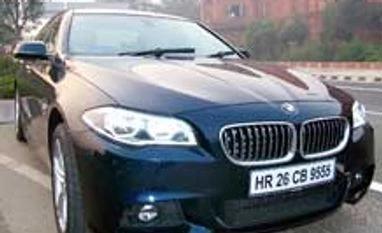 "Flagship premium cars under multiple threats")


 Connect with us on WhatsApp