98% board resolutions get nod in CY18 despite rise in shareholders' dissent

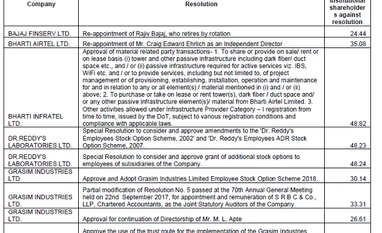
Among the prominent ones that were opposed by the institutional shareholders with over 20 per cent votes include re-appointment of Rajiv Bajaj in Bajaj Finance.
board
board
Swati Verma New Delhi
Last Updated : Feb 14 2019 | 2:36 PM IST
Nearly 98 per cent of proposals put up before the company boards got a green signal in calendar year 2018 (CY18), despite a greater level of institutional investors casting their vote against the decision, suggest a report by Prime Database.

Of 716 resolutions proposed during CY18, 700 (98 per cent) got the approval even as institutional shareholders voted against them, courtesy high promoter holding in the companies, the report says.

“Data-wise, the number of resolutions where more than 20 per cent of institutional shareholders voted against the resolution increased by 14 per cent to 716 in 2018 from 629 in 2017 and 639 in 2016. However, resolutions where over 20 per cent of institutional shareholders cast a negative vote, for Nifty50 companies reduced to 36 in number, against 44 in the same period last year,” the report says.

According to Pranav Haldea, Managing Director, PRIME Database Group, a bulk of these resolutions were related to board appointments followed by stock options and board remuneration.

Among the prominent ones that were opposed by the institutional shareholders with over 20 per cent votes include re-appointment of Rajiv Bajaj in Bajaj Finance and re-appointment of Mr Craig Edward Ehrlich as an Independent Director of Bharti Airtel.


E-voting to the rescue

Haldea attributes the trend to the e-voting facility, which has been made mandatory a few years ago as also the stewardship code brought about by regulators. A 'stewardship code' is a principles-based framework that is designed to assist institutional investors and their stewardship service providers (including proxy advisors) in fulfilling their responsibilities to their clients.

"It is also attributable to a greater role being played by proxy firms as also a steady increase in institutional holding as a whole," Haldea adds.

In contrast, there were 45 resolutions which were completely voted against by shareholders at AGMs / EGMs / Postal Ballots and Court / NCLT Convened Meetings held in 2018, the report says.

Overall, a total of 12,972 resolutions were proposed to be passed in 2,478 AGMs, EGMs, Postal Ballots and Court / NCLT Convened Meetings of 1,744 companies that were listed on NSE as on January 1, 2018 – up 5 per cent from 12,341 resolutions in 2017. 

One subscription. Two world-class reads.

Already subscribed? Log in

Subscribe to read the full story →
*Subscribe to Business Standard digital and get complimentary access to The New York Times

Smart Quarterly

₹900

3 Months

₹300/Month

SAVE 25%

Smart Essential

₹2,700

1 Year

₹225/Month

SAVE 46%
*Complimentary New York Times access for the 2nd year will be given after 12 months

Super Saver

₹3,900

2 Years

₹162/Month

Subscribe

Renews automatically, cancel anytime

Here’s what’s included in our digital subscription plans

Exclusive premium stories online

  • Over 30 premium stories daily, handpicked by our editors

Complimentary Access to The New York Times

  • News, Games, Cooking, Audio, Wirecutter & The Athletic

Business Standard Epaper

  • Digital replica of our daily newspaper — with options to read, save, and share

Curated Newsletters

  • Insights on markets, finance, politics, tech, and more delivered to your inbox

Market Analysis & Investment Insights

  • In-depth market analysis & insights with access to The Smart Investor

Archives

  • Repository of articles and publications dating back to 1997

Ad-free Reading

  • Uninterrupted reading experience with no advertisements

Seamless Access Across All Devices

  • Access Business Standard across devices — mobile, tablet, or PC, via web or app

Next Story



