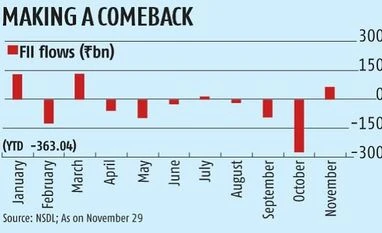
Foreign institutional investors (FIIs) flows have made a comeback. In November, overseas funds invested nearly Rs 64 billion ($890 million) —most since March. The buying helped the benchmark indices rally five per cent—their biggest monthly showing since July.
The reversal of foreign flows comes after two months of heavy sell-off amid surging US bond yields and dollar. Deteriorating macroeconomic conditions on account of weakening of the rupee and surging bond yields contributed to the selling. FIIs pulled out $1.3 billion and $3.8 billion in September and October, respectively, pulling down the benchmark indices by as much as 15 per cent.
With US bond yields and dollar seeing a retreat the risk appetite for global funds has improved, said experts. Also, the sharp rebound in the rupee against the dollar amid a 30 per cent slide in Brent crude prices has significantly improved the macro picture for India, they add. Not just India, but other emerging markets too saw a reversal in foreign flows in November.
The US bond yield has declined more than 20 basis points (bps) from 3.23 per cent in August to 3.01 per cent currently. Also, the rupee has gained 6.5 per cent against the dollar from an all-time low of 74.38 to 69.5 at present.
Experts say the US bond yield and the dollar could slide further, boosting the prospects for emerging markets like India.
“The Fed is expected to pause in the second half of 2019 and US 10-year yield is expected to edge lower to 2.75 per cent by December 2019. Tightening external funding conditions had earlier put current account deficit (CAD)-economies like India and Indonesia on the back foot. This now looks likely to reverse, and will enable their domestic demand stories to come through,” says a note by Morgan Stanley.
Stability in the local currency is a big positive for foreign flows, say market experts. If the domestic currency appreciates, it sweetens the returns for overseas investors. For instance, while the Sensex returned five per cent in local currency terms in November, the dollar-returns are 11.6 per cent.
In November, foreign flows into most EM markets were in line. However, going ahead investors could differentiate in favour of economies such as India and Indonesia, say experts.
“As trade tension lingers, economies with high export orientation and high export market concentration, such as Singapore, South Korea, Taiwan and Malaysia, remain more exposed, while those with low export orientation, such as India and Indonesia, less so,” adds the note by Morgan Stanley.
Experts say the oil price movement has a direct bearing on India’s economic growth prospects as it directly impacts macro parameters such as inflation, current account deficit and fiscal deficit and hence, say experts.
“A 10% fall in oil prices could lower consumer inflation by about 20 basis points, in our view, and would push GDP growth higher by 10 basis points if the price benefit is passed on to consumers,” says a note by UBS.