Mahindra & Mahindra (M&M)’s June quarter performance was broadly in line with expectations led by volume growth and higher share of the more profitable tractor business. While volumes for the auto segment were up 11 per cent to 121,000 units, farm equipment segment (tractor) volumes were up 20 per cent to 74,731 units.
This helped the company report a growth of 11.4 per cent in revenue (net of excise) at Rs 10,525 crore, which was lower than Bloomberg consensus estimates of Rs 11,193 crore. The results include the financials of M&M and its manufacturing subsidiary Mahindra Vehicle Manufacturers, which is what analysts typically consider while evaluating M&M's performance.
At the operating level, the performance card was similar with tractor segment revenues rising 15 per cent to Rs 4,077 crore, while earnings before interest and taxes (Ebit) standing at Rs 768 crore, up 22.5 per cent year-on-year (y-o-y). Thus, the segment’s Ebit margins, too, were at a strong 18.8 per cent, up 120 basis points (bps).
The company indicated higher operating leverage, given the strong volume uptick, coupled with better product mix enabled it to report higher margins. Net profit on the back of higher income and lower tax rate was up 15.9 per cent y-o-y to Rs 962 crore, which was better than estimates of Rs 893 crore. Adjusted for exceptional gains of Rs 91 crore, net profit was up four per cent, in line with estimates.
The auto segment, however, disappointed. Although revenue growth came in at nearly 10 per cent, Ebit was down 16.1 per cent y-o-y. Consequently, margins fell a steep 240 bps. The management cited the expiry of excise duty benefit at the Haridwar plant (impact of 150 bps), higher depreciation costs and due to slew of launches over the last 12 months as the reasons for decline in profitability.
Given the auto segment’s performance, the stock shed 2.2 per cent in trade ending at Rs 1,447.85. The management, however, said if the lack of Haridwar excise duty benefit is adjusted, margins would have have been higher over the year-ago period. What could keep its margins in check is severe competition in the UV segment, with discounting and special offers.
Although the company’s operating profit at Rs 1,489 crore (up 10.7 per cent y-o-y) was better than expectations, overall margins, which were flattish at 14 per cent, are expected to move up given the better volume growth in the more profitable tractor business. The company has revised its industry volume growth guidance for tractors from 10 per cent earlier to mid-teens on the back of good monsoons as well as pent-up demand after two failed monsoons. Notably, the company has been able to gain market share in tractors and the same at 43.9 per cent is its highest since 2007. The company is looking at improving its market share further on the back new launches and current portfolio.
Raw material costs as a percentage of sales were up marginally by 38 bps to 68.35 per cent. The management indicated input costs, which were benign earlier have firmed up a bit. Notably, it has been able to keep costs under control due to internal cost cutting initiatives and lower inventory cost. While any sharp uptick in costs could be detrimental, volume gains should offset some of these pressures.
Positively, some traction in the utility vehicle (UV) space is also expected on the back of a series of launches, the last being KUV 1OO in January. Given the customer preference for petrol variants, about half the KUV 100 sales are for the petrol version. The company indicated it would be launching the petrol versions of XUV 5OO and Scorpio next year with most brands coming with petrol versions after 2018. For FY17, it expects the passenger vehicle sector to grow 8-10 per cent, led by UV where it is the market leader with 31.6 per cent share.
Given the improving prospects, especially in the tractors segment, long-term investors could use corrections to accumulate the stock.

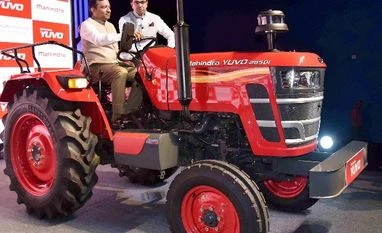 "Mahindra reaps tractor boom, auto disappoints")


 Connect with us on WhatsApp