
Number of demat accounts have more than doubled since March 2019: Tyagi
Top brokerages have been opening nearly a million demat accounts since then and almost 75 per cent of them are under-30 investors
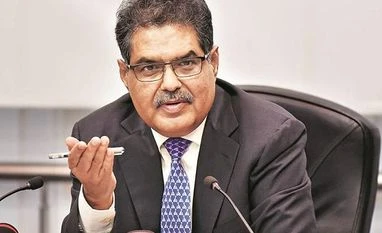 "Number of demat accounts have more than doubled since March 2019: Tyagi")
WebinarsNew
Deep DiveNew
Explore Business Standard
Top brokerages have been opening nearly a million demat accounts since then and almost 75 per cent of them are under-30 investors
What the markets and market-makers have achieved in the past two years is more than what they could do during the past two decades, as the number demat accounts have more than doubled to 7.7 crore as of November 2021 from 3.6 crore in March 2019, Sebi Chairman Ajay Tyagi said on Wednesday.
Since the pandemic-driven lockdowns and work form home culture began, millions of young people have entered the market as first time investors, which was also a period when the benchmarks soared around 150 per cent since the coronavirus-triggered crash in March 2020.
Top brokerages have been opening nearly a million demat accounts since then and almost 75 per cent of them are under-30 investors.
"In line with the global trend, we too have seen a significant increase in the number of individual investors accessing the capital markets. From an average of 4 lakh new demat accounts opened every month in FY20, it tripled to 20 lakh per month in 2021 and has further increased to around 29 lakh per month in November 2021, that is more than 7 times of the monthly average the pre-COVID year of FY20," Tyagi said.
"In fact, the cumulative demat accounts which stood at 3.6 crore as on March 2019, were 7.7 crore as of end November 2021. So, in fact, what was achieved in over two decades in the market has been achieved in the last about two-and-a-half years," he added.
Tyagi was speaking at an event to celebrate 25 years of the Nifty index and 20 years of derivatives trading in the country.
The Nifty 50 index was launched on April 22, 1996. The index, which represents the 50 large and liquid stocks across 13 sectors, has grown 15 times in the past 25 years, delivering annualised returns of 11.2 per cent, NSE chief executive Vikram Limaye said.
On this, the Sebi chief said a well-constructed index not only enables measuring the market performance, but also serves as a portfolio for investment.
Such an index finds use for a variety of purposes such as benchmarking funds, launching of index funds, exchange traded funds, underlying index for exchange traded derivatives and structured products, he noted.
The Nifty constituents capture 63.4 per cent of the free-float market capitalisation and 32.5 per cent of turnover of the entire equity market, based on the average data for June-November 2021, Tyagi said.
As of November 30, 2021, there were 16 exchange traded funds benchmarked to Nifty 50 with total assets under management of more than Rs 1.6 lakh crore, and 18 index funds tracking Nifty with and AUM of around Rs 16,000 crore, apart from seven international ETFs with an AUM of over USD 1 billion, Tyagi said.
NSE is the world's largest exchange when it comes to equity derivatives since 2019. The Sebi chairman attributed this to the combination of good product design and prudent policy framework.
On the NSE, equity derivatives are available on three indices and 197 stocks, he said.
The Nifty 50 index along with Nifty bank index contracts are the most traded index option contracts globally based on number of contracts traded, Limaye said.
The exchange has been the largest derivatives exchange globally for two consecutive years in a row in 2019 and 2020.
Tyagi further said the SGX-Nifty will soon be functional from the IFSC, leading to better liquidity management.
"With a view to coalescing liquidity at one place, measures have been taken by the government and regulator to incentivise trading of derivatives on Nifty at IFSC shortly," he said.
The Nifty 50 index was the first underlying benchmark on which the first exchange traded fund (ETF) was launched in the country. It was also the first index in NSE's derivatives market.
NSE began trading in derivatives with the launch of index futures benchmarked to Nifty 50 on June 12, 2000 in the equity derivatives segment.
This was followed by the introduction of trading in index options (also based on Nifty 50) on June 4, 2001, options on individual securities from July 2, 2001 and futures on individual securities from November 9, 2001, Limaye said.
(Only the headline and picture of this report may have been reworked by the Business Standard staff; the rest of the content is auto-generated from a syndicated feed.)
First Published: Jan 06 2022 | 2:49 AM IST


 Connect with us on WhatsApp