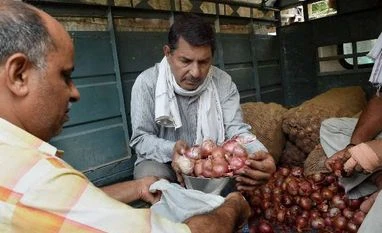
Onion prices go through the roof
Rise 50% in a month, could hit Rs 100/kg in retail market, say traders, with delayed sowing and harvesting due to adverse weather
Dilip Kumar Jha Mumbai Onion prices are spiralling again on a supply crunch and traders fear the retail price might cross Rs 100 a kg, as it did in October 2013.
The price has jumped about 50 per cent in a month. In Delhi, the wholesale price is now Rs 48-52 a kg; the retail one is Rs 80 a kg. At the benchmark wholesale market, at Lasalgaon (Nashik, Maharashtra), the model onion price is Rs 47.50 a kg; the retail market in this city is Rs 60-70 a kg. Stockists at the Pimpalgaon mandi (also in Nashik district) estimate if the current trend continues, the price could hit Rs 70-80 a kg in the wholesale market and Rs 100 a kg in the retail market by the end of September.
A major part of the rabi crop was damaged due to unseasonal rain and hail in February-March. Then, the planting and replanting of the kharif crop was affected because of scarce rain in the major producing states of Maharashtra, Andhra and Karnataka. These three states contribute 50-60 per cent of the kharif onion.
"Prices are rising in anticipation of a delay in the arrivals due to drought-like situation in the major producing states. Large farmers and stockists are bringing less for selling. If the price declines even by Rs 2-3 a kg a day for any reason, stockists lower their supplies, resulting in a spiralling onion price the following day. Since the government has started focusing on onion import now, with MMTC (the government trade agency) asked to bring 10,000 tonnes, perhaps in 15 days the supply will smoothen," said R P Gupta, Director, National Horticultural Research and Development Foundation.
When asked if import of 10,000 tonnes would be sufficient to feed consumer demand, Gupta said, "Once a tie-up is done, we can import frequently. Import is also a game of sentiment. Once import would start, stockists might bring more into the mandis."
The early kharif crop, which contributes nearly a fifth of the annual production of a little over 19 million tonnes, has apparently started to get damaged due to deficiency in rain. And, the late kharif crop -20 per cent of the total - has got delayed due to lack of moisture in the fields for sowing and replanting. Hence, even if rains resume in a week to 10 days, harvesting of the kharif onion crop would be delayed, perhaps by two weeks or a bit more.
"By then (September-end), consumers will have to bear with high onion prices," Ajit Shah, president of the Horticulture Exporters Association, had said recently.
Meanwhile, farmers have started the harvesting pre-matured crop, given the present high prices. At the Lasalgaon mandi, one cart of pre-matured onion (approximately 15 quintals) crop is selling for Rs 35 a kg.
As mentioned earlier, the government has asked MMTC to import 10,000 tonnes within 10 days. However, even if the deadline is met, the landed cost would work out to Rs 33-34 a kg. The imported onion needs to dry in the sun, to reduce its moisture and increase its shelf life. This process will reduce its average weight by at least 10 per cent. Considering transportation and handling, the break-even price would be around Rs 40 a kg. Even if the importer earns a profit of no more than Rs 5 a kg, the selling price would not be less than Rs 45 a kg in the wholesale market, not much difference from the prevailing level now in major markets.
The Delhi city government sold 30,000 kg two days earlier at Rs 30 a kg the quantity was insufficient to meet the rising demand. It could afford to sell at this price since two nominated procurement agencies (of the central government), Nafed and SFAC, had procured 2,500 tonnes and 10,000 tonnes, respectively, a couple of months earlier at the then market price of Rs 15-16 a kg. That was procured under the Price Stabilisation Fund for which the Centre allocated Rs 500 crore in the earlier Union Budget. Such schemes, however, are not available elsewhere.

 "Onion prices go through the roof")


 Connect with us on WhatsApp