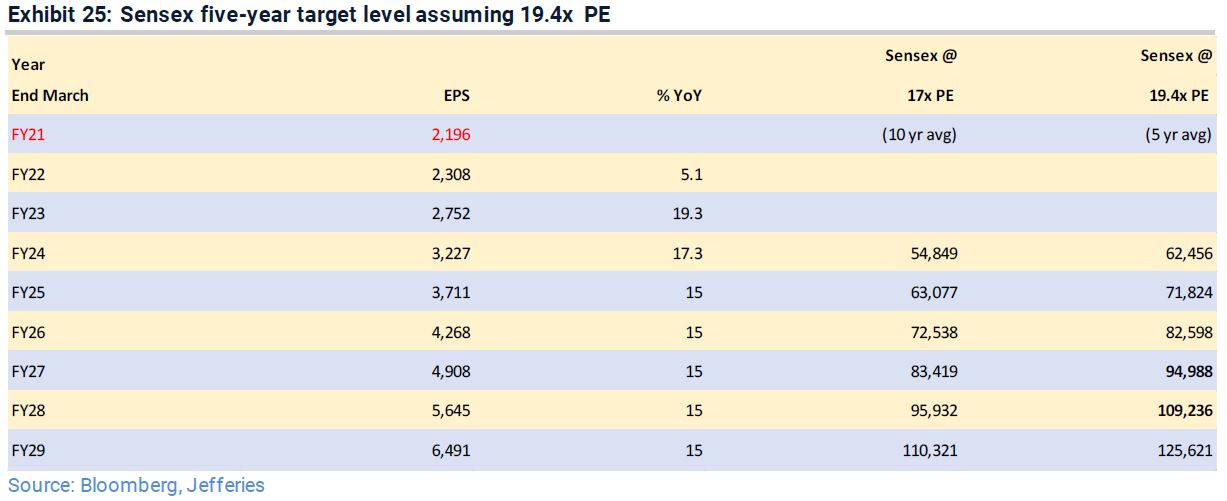
Propelled by high economic growth and strong corporate earnings despite high valuation of the Indian benchmarks (Nifty50 trades at 20.5x one-year forward earnings), the S&P BSE Sensex can hit the 100,000 mark in the next five years, believes Christopher Wood, global head of equity strategy at Jefferies.
The accelerating growth story, Wood believes, is reflected in rising earnings forecasts amid strong economic growth. India, according to him, looks set to record perhaps the best earnings growth in Asia this year, with only Indonesia and the Philippines higher in terms of consensus forecasts.
READ WOOD'S VIEWS ON BUDGET 2022 HERE “The consensus earnings growth forecast for the MSCI India this year is 20.3 per cent, compared with 11.3 per cent for the Asia ex-Japan region. While Jefferies’ India office is forecasting 19.2 per cent earnings growth for the Nifty in FY23 beginning April 1, following an estimated 38 per cent growth in FY22. This follows positive earnings revisions last year. Consensus earnings forecasts were revised up by 14.4 per cent in 2021. The target of a Sensex at 100,000 is now eminently achievable on a five-year view assuming a trend 15 per cent EPS growth and that a five-year average multiple of 19.4 is maintained. The Sensex will hit 100,000 during fiscal 2026-27 (FY27) or sometime in late 2026, based on such assumptions,” Wood wrote in his weekly note to investors, GREED & fear.
India, Wood said, has always been a stock market for growth investors with the multiple to go with it. In a G7 world where value investors may finally enjoy an extended period of outperformance over growth, until at least the Fed performs another U-turn, India, he believes, should be a prime object of focus for growth oriented equity investors, be they Asian and emerging market (EM) investors or global investors.
A similar view was shared by Raamdeo Agrawal, co-founder and joint managing director, Motilal Oswal Financial Services (MOFSL) in May 2021, who suggested that Indian equity markets were on the
cusp of a major bull-run that could propel the S&P BSE Sensex to 200,000 levels in the next 10 years. He too, like Wood, bet on a strong economic growth and healthy rise in corporate earnings over the next 10 years that would help the Sensex reach the 200,000 mark and advised investors not to bet 'against India.'
READ ABOUT IT HERE 
 "Sensex can hit 100,000 mark in five years, believes Chris Wood")










 Connect with us on WhatsApp