Share buyback likely to put additional burden on finances of PSUs

The finance ministry has short listed 11 PSUs for a possible buyback of shares in the ongoing financial year
Share buyback likely to put additional burden on finances of PSUs
Krishna Kant Mumbai
Last Updated : Oct 18 2018 | 5:30 AM IST
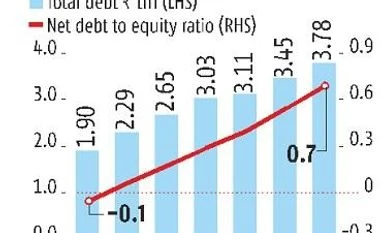
The government’s plan to meet divestment target through share buybacks by large public sector undertakings (PSUs) is likely to put additional burden on their already strained balance sheet. Listed PSUs (excluding banks and oil & gas companies) reported net debt to equity ratio of 0.7x in FY18 (on average), which is the highest in FY18 and up from 0.54x a year ago. 

The last time that PSUs were debt free on a net basis was in the fiscal year ending March 2012. 

According to media reports, the finance ministry has short listed 11 PSUs for a possible buyback of shares in the ongoing financial year. This includes Coal India, NTPC, National Aluminium Company (Nalco) and NMDC among others. 

The other PSUs on the list include NLC India, Bharat Heavy Electricals, NHPC, NBCC (India), SJVN, KIOCL, and Hindustan Aeronautics. Besides, the government also plans to generate another Rs 200 billion through share buyback by public sector oil and gas companies. The market value of these companies too has taken a beating. Combined market capitalisation has declined 14.2 per cent in the last 12 months, underperforming the broader market — the benchmark S&P BSE Sensex is up 8 per cent during the period. 

There has been a sharp rise in companies’ indebtedness in the last few years as PSUs have been liberal with dividend payouts despite sub-par profitability due to adverse commodity cycle and capex cycle in India that drives their growth and earnings.

The PSUs in the sample have distributed around 72 per cent of their current year’s net profits (excluding dividend distribution tax) as equity dividends in last three years, forcing many companies to dip into their cash reserves (or accumulated earnings) to pay dividends. 

Companies’ combined cash and cash equivalent was down to Rs 933 billion at the end of FY18, against Rs 1.65 trillion at the end of March 2015 and a high of Rs 1.98 trillion at the end of March 2011.

Analysts say the buyback may provide some support to share prices of these companies in the near-term but could force many of them to make incremental borrowings hurting their finances. "With the exception of Coal India, none of the large PSUs has surplus cash left to fund buyback on one’s own. Many of the companies will be forced to fund it through fresh borrowing, which will hurt their earnings and balance sheet ratios at a time when interest rates are rising,” says G Chokkalingam, founder & MD, Equinomics Research & Advisory Services.

The 32 listed PSUs in the sample had a total debt of around Rs 3.8 trillion at the end of March 2018, up from Rs 3.03 trillion at the end of March 2015. This, coupled with a steady depletion in their cash reserves during the period, led to a steep rise in PSUs’ net debt position (net of cash and equivalents) during the period. Their total net debt doubled in the last three years from Rs 1.38 trillion at the end of March 2015 to Rs 2.85 trillion at the end of March this year. The buyback is also likely to put financial pressure on energy PSUs, which have lower leverage ratio than other non-financial sector PSUs. 

This, the analysts, say will hurt companies’ balance sheet at a time when their earnings are likely to be under pressure due to government diktat to share a part of the fuel subsidy. 

Energy PSUs reported a net debt to equity ratio of 0.41x on average in FY18 up from 0.32x a year ago. These companies had a combined debt of Rs  2.26 trillion at the end of FY18, marginally up from Rs 2.22 trillion a year ago. Their net debt was, however, up 15 per cent last fiscal due to 34 per cent year-on-year fall in their cash reserves last fiscal.

Energy PSUs have seen a 25 per cent decline in market capitalisation during the past year.

Many of these PSUs on the buyback list top the indebtedness chart. For example, power generator NTPC has the second highest borrowings in the pack with gross debt of Rs 1.3 trillion at the end of March this year and average net debt to equity ratio of 1.2x, while NLC (India), another buyback candidate, reported a net debt to equity ratio of 0.9x.


One subscription. Two world-class reads.

Already subscribed? Log in

Subscribe to read the full story →
*Subscribe to Business Standard digital and get complimentary access to The New York Times

Smart Quarterly

₹900

3 Months

₹300/Month

SAVE 25%

Smart Essential

₹2,700

1 Year

₹225/Month

SAVE 46%
*Complimentary New York Times access for the 2nd year will be given after 12 months

Super Saver

₹3,900

2 Years

₹162/Month

Subscribe

Renews automatically, cancel anytime

Here’s what’s included in our digital subscription plans

Exclusive premium stories online

  • Over 30 premium stories daily, handpicked by our editors

Complimentary Access to The New York Times

  • News, Games, Cooking, Audio, Wirecutter & The Athletic

Business Standard Epaper

  • Digital replica of our daily newspaper — with options to read, save, and share

Curated Newsletters

  • Insights on markets, finance, politics, tech, and more delivered to your inbox

Market Analysis & Investment Insights

  • In-depth market analysis & insights with access to The Smart Investor

Archives

  • Repository of articles and publications dating back to 1997

Ad-free Reading

  • Uninterrupted reading experience with no advertisements

Seamless Access Across All Devices

  • Access Business Standard across devices — mobile, tablet, or PC, via web or app

Next Story



