
Tariff barriers keep India out of Chinese sesame, groundnut markets
China has levied 9% duty on import of sesame seed from India
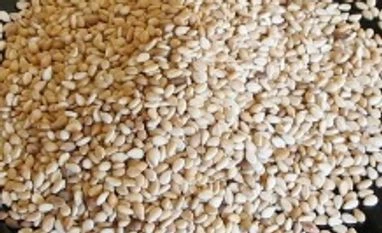 "Tariff barriers keep India out of Chinese sesame, groundnut markets")
premium
WebinarsNew
Deep DiveNew
Explore Business Standard
China has levied 9% duty on import of sesame seed from India
Despite effort, India hasn't succeeded in making an inroad into Chinese sesame seed and groundnut markets, due to a tariff barrier.
Exporters have asked the ministry of commerce and industry for reviewing the Asia-Pacific Trade Agreement, formerly the Bangkok Agreement, of which India and China are members. Signed originally in 1975, it is a preferential tariff arrangement that aims at promoting intra-regional trade. Bangladesh, Korea and Sri Lanka are also signatories.
"The issue was raised several times in the past with the Chinese government but there has been no progress," says Sanjiv Sawla, chairman of the Indian Oilseeds and Produce Export Promotion Council. China imports 800,000 tonnes annually; only two per cent comes from India.China has levied a nine per cent duty on import of sesame seed from India, the world's largest exporter of the product; China is the biggest importer. This has made the Indian export uncompetitive. In contrast, import from a number of African countries have no duty levied.
Sesame is a kharif oilseed, of which India is the world's largest producer and exporter, with annual output of 700,000-800,000 tonnes. For crop year 2016-17, the government estimates seed output at 670,000 tonnes. Sesame seed is used for production of medicinal oil; it is also consumed directly and used in some fast foods varieties.
"If import duty is withdrawn, India would be able to export at least 150,000 tonnes of sesame seed annually to China, worth $300 million," said Sawla.
Similarly, China has a 15 per cent duty on import of groundnut from India, making it uncompetitive. China imports around 300,000 tonnes of groundnut annually. "We can easily export 100,000 tonnes of groundnut annually to China worth $120 mn, if the tariff barrier is removed," said Sawla.
Our export of groundnut to China declined 50 per cent to 15,791 tonnes ($16.3 mn) in 2015-16, from 33,677 tonnes ($34.6 mn) the previous year.
Already subscribed? Log in
Subscribe to read the full story →

3 Months
₹300/Month
1 Year
₹225/Month
2 Years
₹162/Month
Renews automatically, cancel anytime

Premium stories handpicked daily by our editors


News, Games, Cooking, Audio, Wirecutter & The Athletic
Digital replica of our daily newspaper — with options to read, save, and share


Insights on markets, finance, politics, tech, and more delivered to your inbox
In-depth market analysis & insights with access to The Smart Investor


Repository of articles and publications dating back to 1997
Uninterrupted reading experience with no advertisements


Access Business Standard across devices — mobile, tablet, or PC, via web or app
First Published: Feb 25 2017 | 1:25 AM IST


 Connect with us on WhatsApp