Three-fourths of BSE 500 stocks see downward revision in price targets

This scale-back of price targets comes at a time when there is an intense selling pressure in these stocks
Graph
Pavan Burugula Mumbai
Last Updated : May 24 2018 | 6:40 AM IST
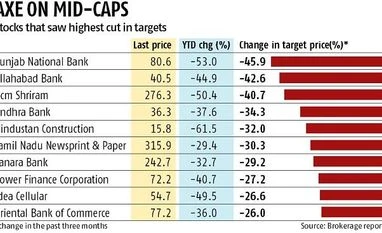
Deteriorating macroeconomic conditions and lacklustre earnings have prompted brokerages to cut their price targets for mid- and small-cap stocks. Over three-fourths of the BSE 500 stocks saw their price targets cut in the last three months, with 98 stocks witnessing a downgrade of more than 10 per cent. The trend looks similar for the BSE Mid-cap and Small-cap indices, where the majority of the stocks are seeing a downward price target revision.

This scale-back of price targets comes at a time when there is an intense selling pressure in these stocks. Brokerages are increasingly advising their clients to avoid any fresh buying in mid-cap stocks even as several scrips in the category have fallen significantly from their 2017 peaks.

The selling pressure in smaller stocks comes after the broader market indices outperformed the Sensex for three consecutive years. So far in 2018, the BSE 500, BSE Midcap and BSE Small Cap indices have fallen over 10 per cent against a modest 1 per cent fall in the Sensex. Analysts say disappointing earnings and weak global cues have prompted this change in stance by brokerages.

“Post the rise in volatility in global capital markets in February, the performance gap between large caps and mid-caps has shrunk to zero since the beginning of 2017. The correction in mid-caps has also brought down the valuation gap between mid-caps and large caps to within one standard deviation of the long-term average,” said Vinod Karki, vice-president (strategy), ICICI Securities.

Banking stocks have taken the most beating in terms of price target cuts. According to data, the price target of scam-ridden Punjab National Bank (PNB) has been cut by 46 per cent in the last three months. The targets for Allahabad Bank and Andhra Bank have also been cut by 42 per cent and 34 per cent, respectively. 

The current correction in the broader markets started in mid-January when investors started trimming their exposure to mid- and small-cap stocks on account of a global sell-off. This correction started with rising bond yields in the US. The pressure on mid-cap stocks continued over the next four months even as the benchmark indices remained range-bound.

Analysts have been warning of overheating in the segment for some time now. Several mid-cap stocks rallied multi-fold despite any meaningful pick-up in their earnings. At its peak, the BSE mid-cap index was trading at a price-to-earnings (P/E) ratio of 45 times against a multiple of 23-25 times for the Sensex. Small caps were commanding an even higher premium with their P/E multiple of 70 times. However, these premiums came without any meaningful revival in their earnings. Policy disruptions such as demonetisation and the goods and services tax (GST) added fuel to the fire.

"Strong earnings are key for any stock rally to sustain. The current correction in the mid and small-cap space is largely on account of poor earnings posted by the companies. However, there are still some midcap companies that have been posting strong earnings. Investors should opt for such stocks," said Pratik Agrawal, chief investment officer, ?ASK Investment Managers .

The last bull cycle in the broader markets started in 2014 when investors lined-up for the smaller stocks in anticipation of superior returns. The liquidity in the segment received a huge boost due to the surging inflows into home grown mutual funds. The BSE Midcap index rallied 171 per cent between 2014 and 2017. Midcaps are typically considered high-beta stocks since they outperform the benchmarks while markets are going up but also tend to fall sharply when markets are headed south.


One subscription. Two world-class reads.

Already subscribed? Log in

Subscribe to read the full story →
*Subscribe to Business Standard digital and get complimentary access to The New York Times

Smart Quarterly

₹900

3 Months

₹300/Month

SAVE 25%

Smart Essential

₹2,700

1 Year

₹225/Month

SAVE 46%
*Complimentary New York Times access for the 2nd year will be given after 12 months

Super Saver

₹3,900

2 Years

₹162/Month

Subscribe

Renews automatically, cancel anytime

Here’s what’s included in our digital subscription plans

Exclusive premium stories online

  • Over 30 premium stories daily, handpicked by our editors

Complimentary Access to The New York Times

  • News, Games, Cooking, Audio, Wirecutter & The Athletic

Business Standard Epaper

  • Digital replica of our daily newspaper — with options to read, save, and share

Curated Newsletters

  • Insights on markets, finance, politics, tech, and more delivered to your inbox

Market Analysis & Investment Insights

  • In-depth market analysis & insights with access to The Smart Investor

Archives

  • Repository of articles and publications dating back to 1997

Ad-free Reading

  • Uninterrupted reading experience with no advertisements

Seamless Access Across All Devices

  • Access Business Standard across devices — mobile, tablet, or PC, via web or app

Next Story



