Ashok Mitra, the unrepentant and unreconstructed Communist intellectual, passed away on May Day. Tributes have been paid to him both as one of India’s leading economists as also one of the CPM’s leading figures in the 1980s. But there were many sides to this remarkable man.
In November 1966, Parliament had been assaulted by cow protection activists mobilised by the RSS. Seven people had been killed in police firing and the Home Minister Gulzarilal Nanda was forced to resign. Some months later in June 1967, Indira Gandhi’s government set up a high-powered committee to examine the issue of having a national law for cow protection. Mitra was then chairman of the Agricultural Prices Commission (APC) and was made a member of this committee that was chaired by a retired chief justice of India A K Sarkar and that also had RSS chief M S Golwalkar and Rama Prasad Mookerjee, the older brother of the founder of the Jan Sangh amongst its galaxy of members. The committee kept meeting for 12 years before it was disbanded in 1979 by Prime Minister Morarji Desai.
No report was submitted but Mitra has left behind a delightful account of the committee’s work in his memorable autobiography, A Prattler’s Tale:
"Guru Golwalkar remained silent during the meetings. Extraordinarily intelligent, modest in manner, soft-spoken, he was fluent in all the 15 languages recognised by the Constitution, and made it a point to converse with me in the most chaste Bengali. A few months after the committee adjourned sine die, I was travelling to Bhopal by train and I found my fellow passenger in the two-berth coupe was Guru Golwalkar. There was no lack of warmth in Golwalkar’s demeanour: we embraced each other and exchanged many stories. When the train picked up speed, casual conversation ceased, both of us took out a book and started to read. Suddenly I noticed that Golwalkar was reading a juicy novel by Henry Miller. The sums just did not add up: the one who led the movement aimed at dragging the country back into the grim valley of retrograde obscurantism, in his spare moments liked to get engrossed in Henry Miller! Inscrutable India!"
Third, Mitra played an important role in Haksar’s own professional career after the latter had left the Prime Minister’s Secretariat in January 1973. Mitra persuaded Haksar to become chairman of the governing body of the Indian Statistical Institute which was passing through troubled times then. A great admirer of ISI’s founder P C Mahalanobis, Haksar became chairman in October 1973 and remained in that position for 25 years, a tenure that will never be equaled either in terms of longevity or contribution. In November 1974, Mitra conspired with the Prime Minister’s Secretary P N Dhar to cajole and convince Haksar to become deputy chairman of the Planning Commission. Haksar was to have a distinguished term of 28 months in this position and it is during this time that the public investment programme in agriculture, irrigation and power revived significantly.

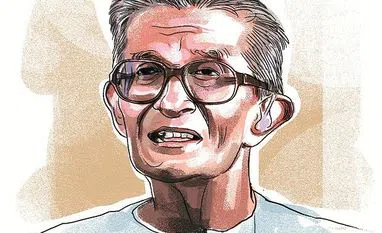 "Ashok Mitra: The unreconstructed Communist intellectual")












