4 min read Last Updated : May 29 2019 | 11:05 PM IST
Many Indian startups, designed on Silicon Valley principles, appear to be aiming to destroy the enemy and to grab the prize of winner takes all. In the process, they are drowning in a dangerous ocean of swirling losses. I cannot understand why so many Indian unicorns are eulogised for business savvy and growth even though they incur every year a loss of three to four times their revenue.
Commenting on Silicon Valley, (April 20, 2019) reported that 12 or so American unicorns that have listed are likely to post combined losses of $14 billion for the last year, with cumulative losses of $49 billion. The poster boy startup for stupidity in funding and management preoccupation with valuations is Theranos. Among well-established companies, Xerox's inability to read emerging consumer needs has been well documented as a case of losing focus.
Cycles of human folly have played out for centuries, so why would people not continue withe their foolish acts? On the flip side, there are magnificent startups that invested heavily, incurred losses but built up unbelievably valuable companies. Remember, it is not the incurring of losses that is incorrect. How come losses work for some, and not for others? Winners are consumer-focused, not competitor-focused. Companies like Microsoft, Amazon and Apple, which invested in deep technologies behaved differently from the undifferentiated, copycat companies that simply out-advertise competitors.
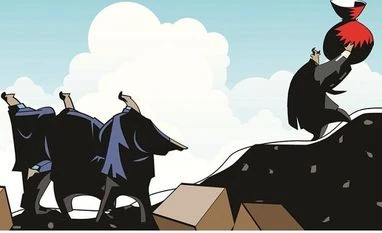
In my book, CRASH: lessons from the rise and exit of CEOs, I have reviewed the pernicious and damaging effects of power on leaders. The suppression of the empathy neurons in the brain results in an over-assessment of their capabilities — recall how Napoleon invaded Russia foolishly in 1812 when he famously said that Impossible is a word found only in a fool's dictionary. Such an arrogant and self-preening leader would be least aware of the effect of power on his or her behaviour.
As argued in some writings (Mark Bonchek and Gene Corfield, Harvard Business Review, April 28, 2016), customers are individuals, who are sort of tiny enterprises. Individually, consumers are changing faster than the company; their needs are quite liquid, and they are concerned with the service that suits them, not with the service provider or the technology. Changing consumer preference is the reason why getting a management’s eye off consumer-orientation produces unintended consequences.
Illustration by Binay Sinha
Modern design thinking lays great emphasis on the role of empathy. This is quite foundational and requires you to put yourself in the hearts of people and experience the feelings of the other person. When the voice of the product, the voice of the system and the voice of the process are all heard together, then an infinitely superior product experience emerges with effectiveness. A technique known as TRIZ is used by experts.
An institution that is competitor-focused to a fault comes through as self-preening and over-confident, especially when a firm has enjoyed a winning spree. During the onslaught of Nirma on Hindustan Unilever’s detergent business from 1970s to mid-1980s, there were many internal discussions about the unfair tactics of the competitor. When the company waded from ankle-deep into hip-deep hot water, a spirited chairman and vice-chairman (Ashok Ganguly and Susim Datta) massively aligned the company back to consumer-focus, creating Wheel. Wheel detergent played a cardinal role in restoring the company’s focus and became a valuable brand for HLL over time.
Patanjali Ayurved started with huge bluster, captured through the personal image of Baba Ramdev. It was highly competitor-focused. The company pretended to be in national service, and about to blast MNCs off their profit-sucking ways. Equity analysts wrote fawning reviews, so did the pink press. Patanjali has lost its way amidst its own competitor obsession.
It is not only companies, but other institutions as well that should avoid competitor-obsession. Among political parties, history suggests that if communications to the voter ooze with self-praise and obsessive derision of the competition, unexpected results can emerge. As examples, recall the self-preening behaviour of the then ruling political parties that lost elections in India in 1977 (Congress) and in 2004 (Bharatiya Janata Party); think of the superbly confident Yahya Khan before the Pakistani elections of 1970, resulting in the East Pakistan revolt.
Arrogant, self-centered, competitor obsession is more than likely to fail — whether a company, a political party or any other institution.
The writer is a corporate advisor and distinguished professor of IIT Kharagpur. During his career, he was a director of Tata Sons and a vice chairman of Hindustan Unilever. Email: rgopal@themindworks.me
Disclaimer: These are personal views of the writer. They do not necessarily reflect the opinion of www.business-standard.com or the Business Standard newspaper




