Everyone knows that if you ask the wrong question, you will not get the right answer. Nowhere is this truer than of political parties, their members, their MPs and MLAs and, that very Indian thing, the anti-defection law.
The tradition, at least in the Westminster type of democracies, has been to focus on the moral aspects of a political party, namely, what social and economic values it stands for. Views have tended to differ on this, which is why we get two broad types of parties: Left and Right.
This would not have mattered so much if what I call “constrained morality” — like what economic theory calls “bounded rationality” — not been introduced in India by the 1985 anti-defection law. It constrained morality, first to 33 per cent and then to 66 per cent, of the strength of a party’s strength in a legislature.
This, if I may be allowed to stretch the analogy further, was the “strict” constraint. Later, a “weaker” version was permitted to allow for mergers into another party by a set of rebels, provided their number came to 66 per cent of the MLAs and MPs from that party.
Then the courts got into the game and mucked about in their usual way. So in the end what we have today, in conceptual terms, is a dog’s breakfast of practicalities, moralities, and hypocrisies.
We can argue about the relative weights of each ingredient and come to different conclusions about our preferences, reminiscent of the Govinda song “Meri Marzi”. But the fact is that there is huge conceptual confusion about the issues involved.
This conceptual confusion has allowed all strong central governments to play ducks and drakes with weak state governments. Karnataka is the best and latest example of this.
I therefore think the time has come to take the help of good old economics, which, like religion, has been mixing practicalities, moralities, and hypocrisies for a very long time. And it has been doing this very successfully.
The basic question a thinking economist, and not a data-driven AI type, would ask is this: Are political parties, their members, and the MPs and MLAs factors of production? What do they actually produce?
I would say that a political party produces policy alternatives, which are the essence of democracy. Its members produce its strength. And the MPs and MLAs produce the laws that are give effect to the alternative ideas and help realise the preferences of the members.
If you think carefully about this, you will get a very strange Ricardian answer: They produce whatever yields the highest returns. And don’t dismiss this as a joke just because you didn’t think of it.
So for the political party, the return is measured in terms of power. For the members of the party it is measured by their sense of community, of “being in power”. And for the MPs and MLAs, it is measured by their preference for pecuniary returns and/or status.
Thus, in purely Ricardian terms, each will adjust itself accordingly to maximise its return. It is perfectly natural.
For those who have forgotten their Ricardo — or, as is more likely these days, were never taught it — David Ricardo was a 19th century English economist who sought to analyse resource allocation in terms of returns to each factor of production. He broke these returns into two parts.
One part was the minimum it needed to earn in order to stay in its current use. The other part was what it would take to lure it to another use.
If this test is applied to the anti-defection law — which was the very anti-thesis of what classical liberalism would demand, namely, the expression of free will and choice by an individual — we can explain the sense of bewilderment that has prevailed since it was introduced.
The fact is this: The third factor in the bundle of the three factors of political production — parties, members, and MPs and MLAs — has been viewed in every way except the one in which it must be viewed, namely, in the Ricardian way.
It is not surprising that the result has been exactly like imposing a moral constraint on, say, a professional sportsman, like a footballer or a jockey. It is a futile attempt at control in a game where the incentive structure is completely Ricardian.

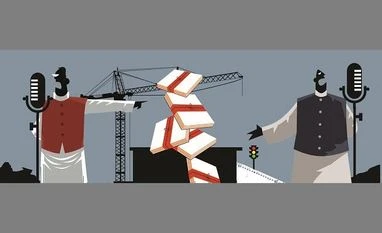 "Defection: A Ricardian view")












 Connect with us on WhatsApp