Fixing insolvency laws
Despite improvement in Doing Business ranking, resolving insolvency (136th position) and enforcing contract (178th place) remain weakest links to make country a business-friendly destination
Sudipto Dey Despite encouraging improvement in the World Bank Doing Business ranking, resolving insolvency (136th position) and enforcing contract (178th spot) remain the weakest links to make the country a business-friendly destination. Business Standard takes a look at what it would take to improve India’s score on these crucial parameters.
In July, Alvarez & Marsal India, a turnaround specialist firm, conducted a survey among 35 professionals associated with bankruptcy and insolvency-related practices to gauge the challenges in reviving stressed assets.
About 40% of the respondents rated execution difficulties as the biggest challenge, followed by difficulties in building consensus among creditors, and the lack of adequate legal rights. The one-third among them blamed insufficient bandwidth of debt recovery tribunal (DRT) and the debt recovery appellate tribunal (DRAT) as a major legal gap in the system.
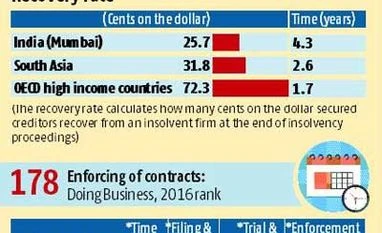
“The judicial process is the weakest link in the bankruptcy regime,” says Nikhil Shah, managing director, Alvarez & Marsal India. The average duration for insolvency resolution in India is 4.3 years compared to the South Asian region’s average of 2.6 years, and 1.7 years in some developed countries.
There are several laws dealing with insolvency-related matter, including the Sick Industrial Companies (Special Provisions) Act, 1985 (SICA), the Recovery of Debts Due to Banks and Financial Institutions Act, 1993 (RDDBFI), and the Securitisation and Reconstruction of Financial Assets and Enforcement of Security Interest Act, 2002 (SARFAESI). There are provisions to restructure loans through the Corporate Debt Restructuring (CDR) route, or through the Joint Lenders Forum (JLF).
The presence of a specialised bankruptcy and insolvency code has been a long-pending demand of the industry and investors. That task was given to the Bankruptcy Law Reform Committee, which came out with a draft code last week to streamline the insolvency laws.
According to Bahram N Vakil, partner, AZB & Partners, who was part of the Bankruptcy Law Reform Committee, the biggest challenge in the implementation of the insolvency code is adhering to the timelines. “If not adhered to, the whole exercise becomes defunct,” says Vakil.
The panel has recommended a 180-day period for insolvency resolution, and setting up of a new regulator to oversee the process.
It lays down a clear system for identification of financial distress and revival of companies, with help of specialist insolvency professionals.
Strengthening the adjudicating mechanism will be an important element in the whole process of fixing the insolvency regime, says Dipankar Bandyopadhyay, partner, Verus Advocates.
Legal experts point out that trained judges will be required to appreciate the merit of an application in a time-bound manner.
“It is important that guidelines are provided in the statute for admission or rejection of an insolvency resolution application,” says Bandyopadhyay.
The competence of the people involved in the insolvency process will play a key role in the success of the new system, feels Ramesh Vaidyanathan, managing partner, Advaya Legal.
The other challenge in revamping the insolvency and bankruptcy regime would be to build a pool of insolvency professionals, and trained judges who understand business issues.
“Adequate number of judges, avoidance of adjournments, and availability of trained personnel at the secretariat of the tribunal are all elements which would contribute towards reducing delays,” says a lawyer who has worked in several cases involving distressed assets. Many like Vakil feel that the work to create a pool of insolvency professionals should start right now, and not wait for the law to come into effect.
Turnaround professionals and legal experts point out that one reason why existing insolvency and bankruptcy laws failed was the opportunity for people to abuse the process. “India must send a strong signal that the new regime will not be used by a dishonest promoter to further private commercial gains,” says Bandyopadhyay.
Many experts and industry practitioners are not in favour of burdening the DRT and DRAT with insolvency cases under the new regime. A majority of the respondents are of the view that it is necessary to have at least one special bench in the National Company Law Tribunal in every state that has a high court for speedier disposal of cases.
The survey notes that the drafting of insolvency code should not be seen as a one-time exercise but as a work-in-progress to strengthen a critical area of the Indian economy. “A mechanism should be provided to amend the law easily. It should be possible to incorporate the lessons from implementation without necessarily going back to Parliament,” says Bandyopadhyay.

 "Fixing insolvency laws")


 Connect with us on WhatsApp