As the asset management industry grows in heft, and within it the index funds gain traction, it is this ability to engage that will influence how corporate India functions
5 min read Last Updated : Apr 20 2022 | 10:41 AM IST
Charles Dow and Edward Jones created the first index in 1896 to provide a sense of whether the market was on the whole going up or down by averaging the prices of individual stocks. Since then, creating and providing indices has become a big business — and a fiercely competitive one at that.
Today, indices such as the Dow Jones Industrial Average and the S&P 500, FTSE 100, MSCI, Nifty and Sensex are among the best-known brands in financial markets. But the index providers did not reach this pole position by tracking the performance of a set of assets in a standardised way. They did so because their role itself morphed into that of drivers of asset allocation decisions through their index inclusions and exclusions. Today, index providers are arbitrators of whether a fund performance has been good or not — because beating the benchmark is the single most important aspect of asset management, making index providers the most influential players in the markets. The attempt to include Indian sovereign debt in the global indices is testament to this.
The decades old active versus passive — rather active versus index tracking debate, is based on a very simple premise: That it is difficult for a fund manager to beat the market in the long run. From the ivory towers of academia, with unsung people like Louis Bachelier and James Lorie, to the more famous Harry Markowitz, William Sharpe and Eugene Fama, to early practitioners in the Wells Fargo Trust Department, to Jack Bogle at Vanguard to Nate Moss at the American Stock Exchange, each has made the case for passive investing, with funds managed passively, swelling to over $15 trillion last year, and with the Big-3 collectively holding, on average, 21.4 per cent of the shares of S&P 500 corporations.
The investment hypothesis is straightforward and rests on two premises. First, the markets are “efficient” because thousands of investors are tracking companies to find mispriced shares. As all known information gets baked into the price, it becomes difficult to find the edge and consistently outperform the market. Second, it is hard to know who has this edge. Both mean buying the market— that is, an index, giving the investor the best risk-adjusted returns.
Domestic markets are not impervious to this thinking. The data from the Association of Mutual Funds in India shows that over the last five years, passive funds (a combination of ETF and Index funds) have grown at a compound annual growth rate of over 70 per cent, from Rs 28,830 crore on 31 December 2016, to Rs 4,18,230 crore by 31 December 2021. Though negligible in the context of the fund management industries’ Rs 37.5 trillion in assets under management, the shift is nonetheless perceptible — with new generation mutual funds all focussing on passive products.
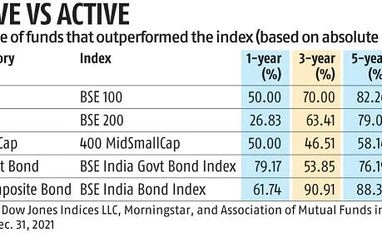
The performance data seems to make a more durable case for passive debt funds, than for equity, as is seen by the S&P Dow Jones Indices annual year-end SPIVA scorecards published last week. This acronymed benchmark measures the performance of active funds relative to their benchmark index, providing data to market participants to make an informed choice on whether to invest in an active or an index fund.
While one did expect that the “active versus index tracking” debate would be settled by now, people continue to line up on either side. Warren Buffett, for one, believes that investors are better off investing in an index fund rather than giving their money to someone to manage. In sharp contrast, there are those, like a team at Bernstein, which believes that passive investing is worse than Marxism, arguing that at least communists tried to allocate resources efficiently, while index funds just blindly invest according to an arbitrary benchmark.
Investors will, however, do well to remember that an index fund guarantees you performance in line with the market and that when the index goes down, they will be hurt. It also completely eliminates the possibility of outperforming the index. It does what it is supposed to do, eliminate the benchmark risk, but not that of the underlying asset. One fear stemming from the rise of passive investing has been that as funds are forced to hold a stock as long as it is in an index, companies will ignore fund manager concerns, accentuating governance risk. But precisely because the fund managers have no choice but to hold the share, they engage more diligently. Not just this, they engage with index providers too, regarding the index inclusions.
As the asset management industry grows in heft, and within it the index funds gain traction, it is this ability to engage that will influence how corporate India functions.
The writer is with Institutional Investor Advisory Services India Limited, a proxy advisory firm. The views are personal. @AmitTandon_in
Disclaimer: These are personal views of the writer. They do not necessarily reflect the opinion of www.business-standard.com or the Business Standard newspaper




