Justice Bobde's agenda

Judicial reforms should happen, finally
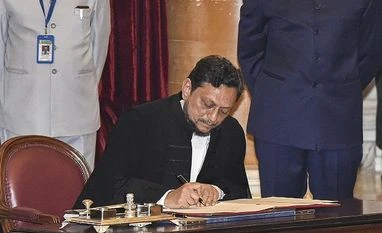
New Delhi: Justice Sharad Arvind Bobde signs on a register after taking oath as the 47th Chief Justice of India (CJI) at Rashtrapati Bhavan, in New Delhi, Monday, Nov. 18, 2019 | (PTI Photo/Manvender Vashist)
Business Standard Editorial Comment
3 min read Last Updated : Nov 24 2019 | 11:33 PM IST
The Supreme Court was back in focus on Sunday as it moved swiftly to address the dispute among political parties on government formation in Maharashtra. Although the matter could not be decided on Sunday, it was reassuring to see how the apex court acted. This efficiency should now trickle down to the rest of the Indian judicial system. India needs judicial reform to address cases in a reasonable time frame. The issue will certainly be on the mind of Justice Sharad Arvind Bobde, the new chief justice of India. 

Many of the problems arise from the neglect of the judiciary by the government. It is provided a paltry amount like 0.2 per cent of the Union Budget. The state Budgets follow the same pattern, year after year. Even the court fees and other revenue collected by the judiciary are taken away by the executive. Registrars of high courts have to panhandle government officials to run the system. As a result, the infrastructure of courts is in an appalling condition. The chief justices who visited subordinate courts have noted that they lack basic necessities such as fans and toilets, let alone a decent library. The consequence is that jails are overcrowded and a third of the prisoners are awaiting trial. The 35.3 million pending cases (1,000 of them 50 years old) hide the violation of human rights.

The problem is further compounded by the reluctance to fill judicial vacancies. There is hardly any court or tribunal in the country which has the sanctioned strength. For the high courts, it is 40 per cent. In the higher judiciary, in addition to the fund crunch, there is the perennial strife between the executive and judiciary played out behind an opaque collegium system of selecting judges. Justice Bobde will have to set the relation with the executive on an even keel on this front. He must also assuage the apprehensions of the public about transfers and appointments of judges by letting in more light into the complex process. It has become vital to retain public faith in the judiciary. 
 

However, the judiciary must also look inwards and do whatever it can without external help. It must set up a permanent constitution Bench to dispose of hundreds of old cases. Law Commission reports have several more suggestions to improve the working of the court. It must regulate adjournments and set a time limit for arguments. The apex court showed it could set a deadline in the Ayodhya case. So it must be made a practice in less politically charged cases as well. Allotting cases to Benches in an irregular manner, exercising the discretionary powers of the chief justice, has caused suspicion in the mind of the public and even led to an impeachment move last year. The much-publicised digitisation has not even touched the paper mountain blocking the overcrowded corridors of the Supreme Court building. The court has a nominal research wing, but it has not conducted an authoritative study on why it has 60,000 pending cases and how to reduce them. These are problems that Justice Bobde knows very well because he practised in the Supreme Court before his elevation to the high court as judge. Perhaps he will agree with former chief justice Ranjan Gogoi, who once remarked that the judiciary needed not just reforms, but a revolution.

One subscription. Two world-class reads.

Already subscribed? Log in

Subscribe to read the full story →
*Subscribe to Business Standard digital and get complimentary access to The New York Times

Smart Quarterly

₹900

3 Months

₹300/Month

SAVE 25%

Smart Essential

₹2,700

1 Year

₹225/Month

SAVE 46%
*Complimentary New York Times access for the 2nd year will be given after 12 months

Super Saver

₹3,900

2 Years

₹162/Month

Subscribe

Renews automatically, cancel anytime

Here’s what’s included in our digital subscription plans

Exclusive premium stories online

  • Over 30 premium stories daily, handpicked by our editors

Complimentary Access to The New York Times

  • News, Games, Cooking, Audio, Wirecutter & The Athletic

Business Standard Epaper

  • Digital replica of our daily newspaper — with options to read, save, and share

Curated Newsletters

  • Insights on markets, finance, politics, tech, and more delivered to your inbox

Market Analysis & Investment Insights

  • In-depth market analysis & insights with access to The Smart Investor

Archives

  • Repository of articles and publications dating back to 1997

Ad-free Reading

  • Uninterrupted reading experience with no advertisements

Seamless Access Across All Devices

  • Access Business Standard across devices — mobile, tablet, or PC, via web or app

Topics :Supreme CourtLaw Commissionjudicial appointmentsJustice SA Bobde

Next Story



