More than 100 days after Donald Trump became president of the United States, his protectionist, isolationist “America first” policy seems to have placed the Indo-US relationship in uncharted waters —whether Trump wants to stop Indian companies from using Indian workers on H-1B visas, or whether his administration merely offers worn-out advice to India and Pakistan about easing tension through dialogue.
How much will India count with Trump? Soon after Trump’s inauguration last January, he and Prime Minister Narendra Modi were quick to invite each other to their respective countries but dates are yet to be fixed. Meanwhile, Japan’s Shinzo Abe and China’s Xi Jinping paid official visits to Washington in February and April respectively. Perhaps, their early official calls highlight the importance of their countries as Asia’s largest and strongest economies — and in the case of China, its growing military power.
Does this suggest Trump will give greater priority to Japan and China than India? Uncertain. But a slackening of ties built up during the Bush and Obama administrations would disadvantage both India and the US. Those 16 years saw agreements on issues as varied as greater Indian access to American technology, America’s support for Indian membership of the Nuclear Suppliers Group and Asia-Pacific Economic Cooperation, and new investment opportunities for the US in energy, infrastructure, information technology and defence.
The uncertainty does not mean Trump is anti-India. His stance on America’s world role will shape his attitude to India and China. During the Bush-Obama presidencies New Delhi and Washington agreed that China’s expansionism posed the main strategic threat to both America’s primacy in Asia and to the security of India and Asia generally. India assumed that Washington would uphold the liberal international order, and, given China’s bellicose nationalism, stand by America’s commitments to its Asian friends. Bush and Obama tried to balance China by building up the power of its neighbours.
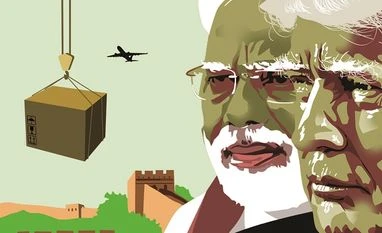
Illustration: Binay Sinha
India seemed a natural ally. Since the 1990s India’s high growth rates — around seven to eight per cent — enhanced its attractions as a counterpoise to China. India’s contested border with China and its position at the centre of a long strategic route that extended from Suez to the Far East increased its strategic weight. India’s growing power and prosperity would simultaneously maintain an Asian balance of power and serve the geopolitical interests of the US worldwide.
As a medium Human Development country, India is no economic or military match for the US. So Washington never expected an exact return. But Bush and Obama held that India’s human and economic resources made it the one Asian country with the potential to contain China. From this thinking emerged the civil nuclear cooperation agreement with India in 2006, to support India’s candidacy for permanent membership in the UN Security Council and the NSG, and growing access to American defence technologies.
India benefited from this thinking: close ties with the US signified “status-by-association”. Responsible for its own defence, India is nevertheless dependent on America’s naval primacy in Asia to counter China in the Indian Ocean (just as Japan remains dependent on the US to secure the East China Sea). In short, the US would continue to underwrite Asian security.
Whether the Trump administration will stick to this policy in Asia is unclear.
Bilateral and global issues are intertwined. Trump’s view of India will be shaped both by his perception of America’s world interests and India’s economic performance relative to China. Will Trump the businessman replace largesse to India with a “business-deal” approach? “America-first” implies that the US carries an unfairly heavy global burden, and Trump has signalled that its friends and allies must do more to defend themselves. Would Trump, therefore, expect India to contribute more to Asian security?
Economics and strategy are linked: More progress is essential to put India on the rails to “great power”.
India must face some facts. High growth rates under Modi have not produced more jobs. Arvind Subramanian, Modi’s chief economic advisor, thinks it will take India 20 to 30 years to catch up with China. Two years ago, trade between India and ASEAN stood at nearly $77 billion; that between China and ASEAN at more than $480 billion.
One persistent problem is that India remains “business-unfriendly”. With India’s current business-friendliness ranking at 130 it is hard to see Modi pulling any rabbits out of his hat to raise India to the top 50, as he assured Obama in 2015. Preoccupied with winning the 2019 election his government is not moving forward on the land acquisition Bill, ending retroactive taxation or reforming outdated labour laws.
For Modi’s Make in India ambitions to be achieved, India needs foreign investment for its infrastructural development and prosperity. But if Trump reduces the corporate tax in the US from 35 per cent to 15 per cent, some American companies currently based in India could be tempted to relocate to the US. This could adversely impact on Modi’s Make in India initiative.
The altruism of Trump’s US may yet make the Modi government realise that only laws giving incentives and confidence to Indian and foreign investors can make India a key driver of Asian security, or a global manufacturing hub rivalling China. All told, a strong tie remains in the interests of the US and India — if only because China challenges both in Asia. The US and India should give fresh impetus to their relationship.

 "Keeping US-India ties strong")












 Connect with us on WhatsApp