Earlier in the day, the two countries signed three memorandums of understanding, including one on the energy sector, and an announcement that the relationship had been upgraded to a “comprehensive global partnership”, a signal that India-US ties seek to go beyond bilateral and regional dimensions to pursuing convergent interests on a global scale. Though the contours of this new relationship were not defined, it could signal closer Indian participation in the Blue Dot Network, the US’s Indo-Pacific initiative to counter China’s Belt and Road Initiative.
On balance, however, the extravagant optics did not mask the fact that the visit yielded little that was substantive, especially for India. For one, Mr Trump was careful to reiterate the good relations he enjoyed with Pakistan’s Imran Khan and China’s Xi Jinping. For another, he spoke of the limited trade deal he has signed with China as a template of the sort of reciprocity he was seeking, underlining India’s rising tariff regime. The $16.9-billion trade deficit (2018-19) between the US and India lurked in Mr Trump’s address. The two sides remained divided over farm products, medical devices, digital trade, and new tariffs, and Mr Trump reiterated that India’s import tariffs were some of the highest in the world. Third, he spoke of the growth of Indian investment in the US, which would have rankled with Indian officials, who were hoping to leverage the visit to bolster foreign direct investment from the US.
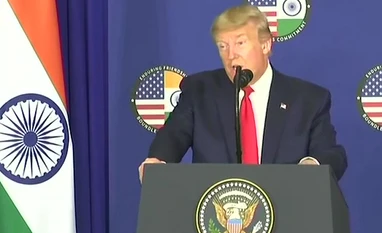
As the two leaders hugged each other several times, smoke was rising into the sky in a part of Delhi because of violence over the Citizenship Amendment Act (CAA). At his press conference at the US Embassy — at which he talked up his record on Afghanistan, West Asia, handling the coronavirus crisis, and so on in his customary rambling style and took potshots at various Democrat opponents — Mr Trump was careful to steer clear of controversy regarding the CAA and Article 370. A muted reiteration of an offer to mediate on Kashmir was followed by a bland observation that there were “many sides” to the issue. The CAA was discussed at the bilateral talks and so was Article 370 but the US president toed the Indian line that these were internal matters. The most remarkable point of the press conference perhaps was his assertion that Mr Modi had assured him that he “wanted the people to have religious freedom”.
All in all, the visit cannot be described as a resounding failure. Nor, despite the guard of honour at Rashtrapati Bhavan, the populous feting in Ahmedabad, and a banquet, can it be described as a notable success. At the very least, it ensured that India was able to defend its interests and that all-important trade talks were not off the table. In a stalling economy, this can be considered a hopeful sign.
One subscription. Two world-class reads.
Already subscribed? Log in
Subscribe to read the full story →
Smart Quarterly
₹900
3 Months
₹300/Month
Smart Essential
₹2,700
1 Year
₹225/Month
Super Saver
₹3,900
2 Years
₹162/Month
Renews automatically, cancel anytime
Here’s what’s included in our digital subscription plans
Exclusive premium stories online
Over 30 premium stories daily, handpicked by our editors


Complimentary Access to The New York Times
News, Games, Cooking, Audio, Wirecutter & The Athletic
Business Standard Epaper
Digital replica of our daily newspaper — with options to read, save, and share


Curated Newsletters
Insights on markets, finance, politics, tech, and more delivered to your inbox
Market Analysis & Investment Insights
In-depth market analysis & insights with access to The Smart Investor


Archives
Repository of articles and publications dating back to 1997
Ad-free Reading
Uninterrupted reading experience with no advertisements


Seamless Access Across All Devices
Access Business Standard across devices — mobile, tablet, or PC, via web or app
)