Stakes are high and no resolution is in sight. This dispute yet again highlights the need to focus on an important aspect of family business that often remains neglected — that of family governance.
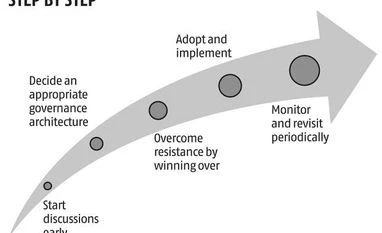
- Start discussions early: Establishing family governance is easier when family businesses are in the early stages of their lifecycle because both the family and business are simple and flexible. Family members have high levels of trust, strong bonding, shared vision and values, and less conflicts and insecurities. Hence they are more open to discussing and accepting new ideas. In contrast, agreements are difficult to arrive at when the family and business become more complex, disjointed and rigid.
- Develop and decide an appropriate governance architecture: Every business family is unique, so is its governance framework. This framework evolves in several rounds of discussions. The scope of a family’s activities determines its family governance architecture. Some families prefer a simple governance mechanism comprising only a family council. Others may develop an elaborate structure with a family business board, family office, family foundation and a family constitution.
- Overcome resistance by winning over: Family members often resist formal governance mechanisms because those impose boundaries. This resistance is high when there is emotional baggage or when changes are implemented from top-down. Sustained dialogue that clears family members’ misconceptions overcomes change resistance. When all family members adopt governance measures by consensus, adherence to those norms is high.
- Adopt and implement: After several rounds of discussion when there is consensus in the family, the family governance framework is formally adopted. An implementation plan with deadlines must also be agreed on. A complex governance architecture may require multiple phases to refine and implement. All family members must be equipped for family governance changes and everyone must participate in its implementation.
- Monitor and revisit periodically: Regular monitoring and feedback is essential to ensure effectiveness of family governance. For this, families can appoint family governance champions. They may hire professional family business advisors to suggest areas for improvement. A periodic review and update would ensure that the family governance system evolves with changing requirements.
One subscription. Two world-class reads.
Already subscribed? Log in
Subscribe to read the full story →
Smart Quarterly
₹900
3 Months
₹300/Month
Smart Essential
₹2,700
1 Year
₹225/Month
Super Saver
₹3,900
2 Years
₹162/Month
Renews automatically, cancel anytime
Here’s what’s included in our digital subscription plans
Exclusive premium stories online
Over 30 premium stories daily, handpicked by our editors


Complimentary Access to The New York Times
News, Games, Cooking, Audio, Wirecutter & The Athletic
Business Standard Epaper
Digital replica of our daily newspaper — with options to read, save, and share


Curated Newsletters
Insights on markets, finance, politics, tech, and more delivered to your inbox
Market Analysis & Investment Insights
In-depth market analysis & insights with access to The Smart Investor


Archives
Repository of articles and publications dating back to 1997
Ad-free Reading
Uninterrupted reading experience with no advertisements


Seamless Access Across All Devices
Access Business Standard across devices — mobile, tablet, or PC, via web or app
)