Shekhar Gupta: Long march to peace with Pakistan

India needs to invest in its military to scare Pakistan to peace and at the same time get Indians to understand the realities of war, writes Shekhar Gupta
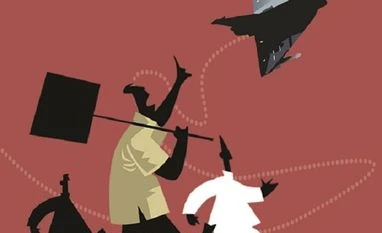
Illustration by Binay Sinha
Shekhar Gupta
7 min read Last Updated : Mar 09 2019 | 5:50 PM IST
Kitney aadmi thhey (how many enemies were there), asked Gabbar Singh, the most feared yet adored villain of Hindi cinema, mocking his punch-drunk hitmen just back from a skirmish in Ramesh Sippy’s 1975 classic Sholay.

Now, why am I using this in the context of last we­ek’s 90-hour India-Pakistan “war”, or describing the nuttiness into which we have descended post-27 Fe­b­ruary, as ‘Gabbarisation’ of our politico-strategic discourse.

It is as if only three questions now remain: Did the bombs/missiles hit the Jaish facility or not? If they did, how many did they kill (hence, kitney aadmi thhey)? And the third: Did the IAF shoot down a PAF F-16 or not? These entirely miss the nub of the issue.

We had written two weeks back that revenge was an unwise strategic impulse. That revenge was for id­i­ots, while the wise prefer dissuasion and deterre­nce. These three questions reflect a revenge mindset, unfortunate for a nation of our size, power and pretensions. It’s the reason we call it “Gabbarised”.

Illustration by Binay Sinha
The prime minister himself has given fuel to it by th­­u­­m­ping his chest and saying to cheering crowds that his na­ture (fitrat) is such that he cannot wait long to take revenge. It is a dangerous politicisation of strategic response. Your military wants surprise to be on its side, not predictability that the adversary can easily “game”.

And second, it could be an ad­m­ission that you do not think what you’ve done is enough to d­e­ter Pakistan. I may be over-in­t­erpreting campaign rhetoric. But rhetoric can also limit your options.

On the other hand, if the prime minister feels that th­ese audacious strikes haven’t produced deterrence, the new normal the subcontinent must prepare for is different from what is best for India. A cycle of terror-retribution-escalation-de-escalation is just two st­eps higher but no different than the completely wa­s­teful blood-letting that’s been going on across the Li­ne of Control. The only difference is that instead of sm­all arms, mortars, sniper rifles and commando-kn­i­ves, fighter planes and smart munitions will be us­ed. This is heady for defence nerds and teenagers. Un­fortunately, it is also a strategic compromise if not de­feat, as Lt. Gen. H.S. Panag (retd) argued in his very wise and brave article earlier this week.

Let’s list the positives first. For the first time since this cycle of Pakistani-controlled terror-subvers­i­on began in Punjab (1981) and Kashmir (1989), India d­rew a line on its tolerance levels. In the past, provoc­a­tions much graver than Pulwama, such as the Par­l­i­ament attack and 26/11, had passed without retaliat­i­on. The Indian response had become predictable and the world was getting bored.

Direct retaliation now was the logical option. Pakistan has, therefore, been given three important messages at Balakot:

  • That there is a threshold of tolerance beyond which India will strike deep inside the Pakistani mainland, unmindful of escalation. To that extent, Pakistan’s post-1990 nuclear bluff has been dented. It isn’t over, but Pakistan now has to factor in this new reality.

  • That India has the muscle to carry out such reprisals and the ability to maintain operational secrecy.

  • And third, that the key powers of the world now ac­c­ept India’s right to retaliate. It follows that India is su­bsequently expected to behave responsibly and, po­int made, should avoid getting caught in a retaliatory cycle.

This is how the game played out this time. But we should also count the negatives. So here again, the rule of three examples:

  • The strikes, counter-strikes and Indian response ex­posed the inadequacy of conventional asymmetry be­tween India and Pakistan. In terms of technology, we­aponry and capability, the two sides are about ev­e­nly matched if the engagements are episodic. In a lo­n­ger war of attrition, India will outlast Pakistan. In sh­ort, India has conventional superiority to ultimately prevail over Pakistan, but not for punitive domination.

  • A fast-developing situation like this needs great communication planning with your own people, media and the world. The Modi government has done poorly on this.

  • As with the Kandahar hijack, Indian public opinion again proved to be the weak link. The same public that clamours for a decisive all-out war, or “aar-paar ki ladayi”, lost its nerve with just one PoW in Pakistani custody. By the evening of the air skirmish, “punish or crush Pakistan” type hashtags had been replaced by “Bring Back Abhinandan”. Fed the easy jingoism of Uri-style movies, the Indian public has forgotten that in real war both sides take losses. And sometimes setbacks too.

In short, this crisis taught India that to embark on a new, low-tolerance, punitive approach towards Pakistan on terror, it has a long way to go militarily and temperamentally. India’s leaders, therefore, have to invest money to achieve the first, and emotion in the second. This kind of a cycle can play out maybe once more, or at the most twice. History won’t take a vacation then and Pakistani conduct won’t so easily reform.

In fact, if this is the new normal, Pakistan and the international community will get used to it. I strike, you retaliate, then I retaliate and we go home at some point. Then we both declare victory to our respective populations, who love their armed forces far too much not to believe it. 

India needs to first make its people understand what war is. Too many are brainwashed watching the footage of American air and drone strikes, where they have total control of the skies. Or movies stirring but so idiotic they have to invent capers straight out of some old ‘Vijay Jasoos’ type pulp to conjure up “gadgets” like Uri’s “garud”. Real-life fighting isn’t a walk through a Hamleys toy shop.

Even if your soldiers are Sunny Deol and Vicky Kaushal, Pakistanis are no Johnny Walkers. They too are tough fighting soldiers, children of the same soil. The one lot who never takes them lightly is India’s professional soldiers. That’s why they keep winning the real wars. It is for the leaders to drum this also into their people’s heads. But if all they do is exploit the forces for their jingoistic politics, strut about in camouflage fatigues and trivialise the military, they are being unwise.

Finally, to have dissuasive, deterrent strategy is a great idea. It is also imperative. But this would need a punitive ability that also dissuades Pakistan from retaliating. Otherwise you be prepared for a new, sub-nuclear mutual deterrence. India tells Pakistan you will ultimately lose a war of attrition, and Pakistan says, militarily, maybe. But economically the stakes are much higher for you.

Here’s one way out. Up your defence budget to a fixed 2 per cent of a rising GDP. Just that it adds about 25 per cent to our current defence spending. Reform the forces. Gen. Bipin Rawat has a great plan for the Army, for example. Optimise them for conventional and decisive punitive deterrence. Throw the gauntlet at Pakistan. They will calm down, or pauperise themselves catching up. It might just make them rethink from their brains for once as they tie up their $12 billion IMF bailout. Remember, the best militaries are ones so powerful and dominant that you do not have to use them. India can afford to have one such. 
By Special Arrangement with ThePrint

One subscription. Two world-class reads.

Already subscribed? Log in

Subscribe to read the full story →
*Subscribe to Business Standard digital and get complimentary access to The New York Times

Smart Quarterly

₹900

3 Months

₹300/Month

SAVE 25%

Smart Essential

₹2,700

1 Year

₹225/Month

SAVE 46%
*Complimentary New York Times access for the 2nd year will be given after 12 months

Super Saver

₹3,900

2 Years

₹162/Month

Subscribe

Renews automatically, cancel anytime

Here’s what’s included in our digital subscription plans

Exclusive premium stories online

  • Over 30 premium stories daily, handpicked by our editors

Complimentary Access to The New York Times

  • News, Games, Cooking, Audio, Wirecutter & The Athletic

Business Standard Epaper

  • Digital replica of our daily newspaper — with options to read, save, and share

Curated Newsletters

  • Insights on markets, finance, politics, tech, and more delivered to your inbox

Market Analysis & Investment Insights

  • In-depth market analysis & insights with access to The Smart Investor

Archives

  • Repository of articles and publications dating back to 1997

Ad-free Reading

  • Uninterrupted reading experience with no advertisements

Seamless Access Across All Devices

  • Access Business Standard across devices — mobile, tablet, or PC, via web or app

More From This Section

Disclaimer: These are personal views of the writer. They do not necessarily reflect the opinion of www.business-standard.com or the Business Standard newspaper
Next Story



