MGNREGA today and tomorrow

The programme is providing relief today, but how can it ensure the basis of livelihood security in the future?
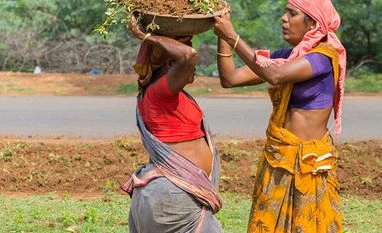
A group of women employed in the NREGA scheme clean the side of the road. (Photo: Shutterstock)
Sunita Narain New Delhi
5 min read Last Updated : Sep 06 2020 | 10:37 PM IST
In these darkest days of Covid-19 — when jobs and economies have collapsed — 56 million households got work in the past three months and these jobs provided relief. This was under the Mahatma Gandhi National Rural Employment Guarantee Act (MGNREGA), which perhaps is the largest social net scheme in the world. Down To Earth reporters, who travelled to different regions of the country, found there was a surge in employment and in many places, the most skilled and educated turned to this programme. It effectively put a floor to poverty — people got jobs, though unskilled and manual — but the jobs gave them money, albeit only a daily wage, and the money provided them the ability to buy food to feed their families.

The question is how this massive job creation programme can be worked so that the assets created are durable. The programme is providing relief today, but how can it ensure the basis of livelihood security in the future? This is where our focus needs to be.

Under this scheme, from April to June, when the virus crisis was hitting hard and people were returning to their villages, over 600,000 water-related structures were built or repaired. In other words, people were given employment close to their homes to dig ponds or build check-dams or repair the village tank that was not functional. In the rains that followed, these water-conservation measures would have not only played a big role in recharging groundwater and mitigating floods — each pond or tank is the sponge that holds the floodwater for the coming dry period. These then improve agriculture — remember the bulk of India’s farms are irrigated not by canal water but groundwater. So, everything we do to capture the rain where it falls, and everything we do to conserve that water, paves the way for economic growth.

While travelling, my colleagues found many water structures were built in this period. So, work has happened. The question now is to measure the sustainability of this asset — is it durable? Does it lead to improved water availability? This is equally crucial but as yet, there is little evidence to show that this change is being monitored for its sustainability.

According to the government dashboard on the MGNREGA, between 2017 and 2018 (only one year), 1.3 million works were done in the area of water conservation and groundwater recharge. If you add the works on farm ponds — another 350,000 — then we should have created a huge capacity for water conservation in the country. 

Just think of this in another way — simple arithmetic. There are some 650,000 villages in India (2011 Census), and so, if we were to compute, then each village should have at least four water conservation works done in one year itself. Since this is cumulative — new structures are built each year — then over time, we should not have had any water crisis at all!

But we do. There is a massive and crippling water shortage in our villages, and lack of drinking water comes at the price of bad health. The government of India has said, rightly so, that its drinking water mission is not about building hardware, but about water in taps. Water in taps in households can be secured only when groundwater recharge is effective and sustainable. This then requires water structures to hold and capture rain. So those millions built under the MGNREGA must be linked to catchment systems; they need to be functional; and have to be measured and monitored — not in terms of works but in terms of assets.

This is where the problem still lies. Even today, the scheme only tracks the “works”. There is little information — other than in the case of farm ponds, which are invariably built on private lands — on water conservation structures and how “functional” they are. The Jal Shakti ministry has said that it will now track progress in terms of water recharge by these structures. This is welcome. 

This will make the programme go beyond the work of today — important as it is — to build and strengthen the ecological foundations, or the natural capital, for the livelihoods and resilience for tomorrow.

What is also important is that the “nature” of work has been expanded — from vermicomposting to planting trees. In addition, the government has allowed for works to be done in private lands for households below the poverty line — even building toilets or septage systems. Between April and August, when Covid-19 had driven economies to the ground, under the MGNREGA 15.5 million individual works were done. This included everything — from making cattle-sheds and farm ponds to even fencing on lands. Poor people improved their ability to secure their futures and they were paid for this labour — which, in turn, gave them that critical safety net.

I write this because I know we are so cynical about these labour schemes — we say that this is the Keynesian way of digging holes and roads that get washed away every season. It is unproductive labour. Then, of course, there are those of us who would dismiss this as another corrupt scheme that adds to the patronage of the locally elected elites — and there is plenty of that going around. But, let’s also consider the opportunity that this right to work programme presents, not just in Covid-19 times, but for times to come. But this means that the “right to work” must be transformed into the “right to livelihoods”. 

The writer is at the Centre for Science and Environment | sunita@cseindia.org; Twitter: @sunitanar


One subscription. Two world-class reads.

Already subscribed? Log in

Subscribe to read the full story →
*Subscribe to Business Standard digital and get complimentary access to The New York Times

Smart Quarterly

₹900

3 Months

₹300/Month

SAVE 25%

Smart Essential

₹2,700

1 Year

₹225/Month

SAVE 46%
*Complimentary New York Times access for the 2nd year will be given after 12 months

Super Saver

₹3,900

2 Years

₹162/Month

Subscribe

Renews automatically, cancel anytime

Here’s what’s included in our digital subscription plans

Exclusive premium stories online

  • Over 30 premium stories daily, handpicked by our editors

Complimentary Access to The New York Times

  • News, Games, Cooking, Audio, Wirecutter & The Athletic

Business Standard Epaper

  • Digital replica of our daily newspaper — with options to read, save, and share

Curated Newsletters

  • Insights on markets, finance, politics, tech, and more delivered to your inbox

Market Analysis & Investment Insights

  • In-depth market analysis & insights with access to The Smart Investor

Archives

  • Repository of articles and publications dating back to 1997

Ad-free Reading

  • Uninterrupted reading experience with no advertisements

Seamless Access Across All Devices

  • Access Business Standard across devices — mobile, tablet, or PC, via web or app

More From This Section

Disclaimer: These are personal views of the writer. They do not necessarily reflect the opinion of www.business-standard.com or the Business Standard newspaper

Topics :CoronavirusLockdownMGNREGAMGNREGA fundspovertyRural incomemigrant workersEmployment in India

Next Story



