Facebook is a great leveller. But, by being so, one often gets neither a clear picture nor the consequences of a major event. This is especially so from November 8, 2016, with Narendra Modi’s momentous demonetisation of Rs 500 and Rs 1,000 notes. Of the many posts on the subject, the vast majority convey frustration and anger, while some sing pro-Modi hosannas. Barring a few newspaper articles, I haven’t read one solidly argued economic case on the subject. Certainly not on Facebook.
To my mind, there are eight issues regarding demonetisation that need to be raised.
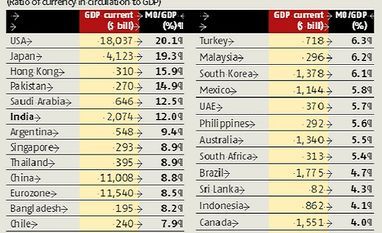
1. Before demonetisation, was India sloshing with extra cash compared to other major nations of the world? The answer is “yes”. Data from Trading Economics (www.tradingeconomics.com) are in the table. It gives the share of the currency in circulation, called M-Zero or M0, to a country’s GDP at current prices. We have been a significant outlier. Versus a 26-country (including the Eurozone) median of 7.4 per cent of nominal GDP being the currency in circulation, India’s stood at 12 per cent in 2016. It is not a small deviation, for it translates into pots of excess cash. Were we the worst? No. The US has a ratio of 20.1 per cent and Japan 19.3 per cent. These countries, too, are sloshing with superfluous cash, though the US dollar is a currency prevalent all over the world. But that they are hardly implies that we are not. Two of our neighbours — Bangladesh and Sri Lanka — have significantly lower ratios, the former at 8.4 per cent and the latter at 4.3 per cent. Indeed, 20 of the 26 countries have lower ratios than ours.
2. What does a major demonetisation do? If accompanied by equivalent re-monetisation, it does nothing but cause enormous hardship in the interregnum. However, if demonetisation is accompanied by lower re-monetisation and thus reduces the currency in circulation, it does two things. First, it constrains output in the short run, as sellers and buyers struggle with a system long used to “last-mile” cash. There should be no significant demonetisation effect for October-December 2016. But I expect a reduction of 0.75 percentage points of real GDP in January-March and April-June 2017. Thereafter, it should gradually peter out, as India adjusts to 20-25 per cent less currency. Second, it forces many people towards cashless transactions via debit and credit cards as well as e-payment platforms. This is where we will witness the success or failure of Modi’s megaton bomb.
5. Could this have been done gradually? Like shaving off five per cent of the currency in circulation annually over the next five years? Technically, “yes”. But that would have played no role in rapidly accelerating the process of non-cash based transactions and e-payments.
6. Has the RBI covered itself with glory? “Yes” and “no”. The mints have worked 24x7 to produce new notes and, despite logistical nightmares, supplied currency chests across India. The RBI and the banks have put their best foot forward. Equally, the governor has been shockingly silent, given the size and importance of this intervention. It was his duty to reassure the citizens, and offer fortnightly details of key facts. He hasn’t, and has been more exasperating than airline ground staff who give neither reason for nor an estimate of flight delays.
7. Was it dictatorial? Yes. Modi decided that it was right for India. He gave the diktat; others danced to the tune.
8. Will it be good for India? If the payment gateways take off, it should create an economy using progressively less cash for the same level of activity. It would also build an identifiable chain which is essential to track money. However, it is silly to believe that “black money” transactions will disappear. Cash will grease the falsifying of land records and property registers; income tax officers will still demand bribes; municipal offices will milk citizens for “no objection” certificates. Worth seeing what Modi does on this score.

 "<b>Omkar Goswami</b>: The economics of demonetisation")












 Connect with us on WhatsApp