Shekhar Gupta: Because, tomorrow always comes

There are many scary scenarios about how badly we Indians may be affected or how many killed by COVID-19. But they presume 1.36 billion people will do nothing to influence their fates
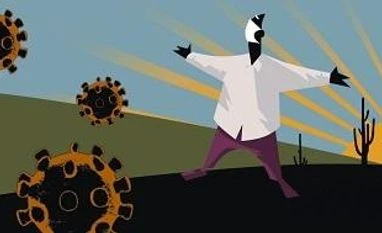
illustration
illustration
Shekhar Gupta
7 min read Last Updated : Mar 28 2020 | 12:28 AM IST
In the coronavirus season, we are daring to pick on two widely accepted truisms. The first, that tomorrow never comes. And the second, famously attributed to economist John Maynard Keynes and brought back to us by Dr Manmohan Singh in the course of the Parliament debate on demonetisation: In the long run, we are all dead.

The mood is so despondent that optimism carries the risk of being called insensitive. The nastiest virus in two generations is travelling the world, needing no passport or visa, and travelling on other people’s tickets.

Since the virus is “novel”, no one, king or commoner, is immune to it. It treats all human beings fairly, with some preference for the famous and the powerful. Check out Prince Charles, Boris Johnson, Sophie Trudeau, Tom Hanks, global star-chef of Indian origin Floyd Cardoz, and so on.

If it was something hitting just the rich and powerful, the majority could’ve even treated it with schadenfreude. That, sadly, is not the case. Because it is coming for all of us. In various countries, epidemiologists say between 50 and 80 per cent people will ultimately get infected with this, until we find a vaccine, develop “herd immunity”, or both.

But these percentages are irrelevant. It is now another flu that will stay on our buffet of deadly viruses, and we will learn to deal with it. A very vast majority of us will catch it at some point, about 8 out of 10 won’t feel much worse than a common cold’s nuisance, if at all, but some will die.

A very, very vast majority, at least about 98 per cent of those infected, if not more, under any circumstances, will live through it. So that underpins our argument with the first of those supposed truisms: Tomorrow never comes. 

Let us say, instead, tomorrow always comes.


Indeed, tomorrow never comes if you are lazy, fatalist or defeatist: ‘Aaj kare so kal kar, kal kare so parson (leave what needs to be done today for tomorrow, and what must be done tomorrow for the day after), is a familiar old Hindi taunt for the procrastinator. But, tomorrow will come. So, you better figure out what you’ll do meanwhile.

Keynes now. Sure as hell, in the long run we are all dead. But two questions arise. What do we do with the time we’ve got meanwhile? Just wait to be dead eventually? Most living beings are never known to live like that, looking forward to death. Most do their damnedest to make their lives longer. Even a wretched virus, which is only about half-way a living being biologically.

The second question then: Who decides how long — or short — is that “long run”?
There are many scenarios about how many of us Indians may be affected or killed by the virus. Epidemiology is in vogue right now. There are as many estimates therefore as real epidemiologists, pop-epidemiologists, and economists, or snake-oil traders pretending to be epidemiologists.

At one extreme, someone predicts millions of us will die, and maybe half a billion will get infected by July. At the other, we are told no such thing can happen, the virus will pass us by, our hot weather will vaporise it and what does the little fellow know about the formidable South Asian immune systems. It is tempting to say the usual: That the truth must lie somewhere in between the two. But it doesn’t.

Because, this presumes we, the 1.36 billion people of India, will do nothing to influence our own collective and individual fates. No people submit themselves to the tyranny of statisticians with fancy projections presuming variables like human and state intervention constant.

I am of the generation that has seen three full-fledged wars (including one humiliating defeat, 1962, and a great victory, 1971), famines, the Green Revolution, ration queues, ‘red’ American wheat that my mother complained about endlessly for being too hard to be rolled into rotis, small pox outbreaks, four insurgencies rise and fade in the northeast, terrorism in Punjab, the chronic challenge of Kashmir, Babri Masjid, decades of the ‘Hindu Rate of growth’ and economic reform, 16-year waiting lists for Bajaj scooters and Hero becoming the world’s largest maker of two-wheelers, a “voucher” for an LPG connection from my local MP (Krishan Kant, later vice-president of India) in Chandigarh from his quota as a wedding gift, and an India where almost 100 million connections are given out free. 

Footnote: I didn’t even get that connection as my MP had exceeded his quota.

My generation has seen both, an India where going overseas meant filling a dozen forms for your $20 quota, or where as a journalist travelling overseas to cover the big wars of the day, you had to line up at the Reserve Bank of India for a permit that would let you draw $165 a day for all expenses, to now when any Indian can freely send up to $250,000 overseas through regular banking channels. If there is one thing we can say with certainty about our chaotic country, it’s that it is always changing. It never freezes. It isn’t North Korea. No insult to that country, just that we are not that disciplined.

Let’s talk about disease and epidemics. Our parents saw plague outbreaks, by our time they had been conquered, never mind that minor commotion of 1994 in Surat. My generation would carry two or three sizeable scars on an arm or on the hip from small pox vaccinations. That scourge was eradicated in 1980. Indians born then on, or up to 40 years of age already, do not know what that scar is.

My generation, and I personally, survived measles, mumps, at least three spells of typhoid, and god knows what else in small towns which mostly had only one ‘MBBS’ doctor, in the overcrowded, ramshackle civil hospital. He diagnosed your fevers, set your broken bones, stitched your wound from a dog-bite, diagnosed the dreadfully painful rash on your mother’s arm as Herpes Zoster (shingles). In 1968.

Talking of shingles, you have to be old enough to have endured chicken pox first. Because the shingles virus comes riding it, sits in your body for decades, and raises its awful head whenever your immunity is lower or as you grow older. Chances are no Indian under about 30 years of age today will ever get shingles. Because they ducked chicken pox, thanks to a vaccine popping up and being added to our universal programme.

War-gaming is a sexy pursuit. Sexier still if you can project more people dying, the end of the world. And so convenient when those dying aren’t your own. I hear and read that on global media. An almost regretful incredulity and questions like: So how come India has such low numbers (Richard Quest, CNN last week)?

Read the history of war-gaming and you will know why most of these geniuses go wrong. Because, they overlook what the “other” side will be doing. That “other” side is we, the people of India, our democracy, free media, civil society, and our noise. You may or may not like Narendra Modi, but even Mr Modi’s India isn’t Mao’s China, where tens of millions would die of hunger and disease and simply ploughed into the ground as manure. This India will bring you in real time the sight of casual labourers walking back home hundreds of miles away, break your heart, and make any government do something about it.

The short answer, therefore, is while in the long run we will all be dead, we will not be waiting, but doing something meanwhile to stretch that “run”. Just that we need to make use of today to build ourselves a better tomorrow. Maybe closing some other dubious and fixable health issues where we sadly top the world: Tuberculosis, blindness, uterine cancer, even rabies. 

Because, remember, tomorrow always comes.
By special arrangement with ThePrint

One subscription. Two world-class reads.

Already subscribed? Log in

Subscribe to read the full story →
*Subscribe to Business Standard digital and get complimentary access to The New York Times

Smart Quarterly

₹900

3 Months

₹300/Month

SAVE 25%

Smart Essential

₹2,700

1 Year

₹225/Month

SAVE 46%
*Complimentary New York Times access for the 2nd year will be given after 12 months

Super Saver

₹3,900

2 Years

₹162/Month

Subscribe

Renews automatically, cancel anytime

Here’s what’s included in our digital subscription plans

Exclusive premium stories online

  • Over 30 premium stories daily, handpicked by our editors

Complimentary Access to The New York Times

  • News, Games, Cooking, Audio, Wirecutter & The Athletic

Business Standard Epaper

  • Digital replica of our daily newspaper — with options to read, save, and share

Curated Newsletters

  • Insights on markets, finance, politics, tech, and more delivered to your inbox

Market Analysis & Investment Insights

  • In-depth market analysis & insights with access to The Smart Investor

Archives

  • Repository of articles and publications dating back to 1997

Ad-free Reading

  • Uninterrupted reading experience with no advertisements

Seamless Access Across All Devices

  • Access Business Standard across devices — mobile, tablet, or PC, via web or app

More From This Section

Disclaimer: These are personal views of the writer. They do not necessarily reflect the opinion of www.business-standard.com or the Business Standard newspaper

Topics :CoronavirusLockdownPM Narendra ModiManmohan SinghBabri MasjidJammu and KashmirReserve Bank of IndiaBoris Johnson

Next Story



