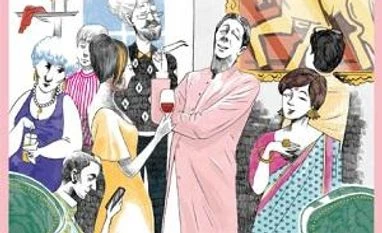
Last month I wrote that book-wise at least, the last six months have been very lucky for me because I have constantly discovered new authors and some very nice books. I am happy to report that my luck hasn’t run out, as I found out earlier this month.
I came across, totally by accident, a book of short stories by none other than the youthful principal economic adviser to the finance ministry, Sanjeev Sanyal. I knew he had written some books on rivers and seas. But I had no idea he has written a book of short stories.
It was while browsing on Amazon that I saw his book on the usual menu of offers. When I saw the price, I decided to take a flutter. It was a good bet, Rs 250 well spent because as a connoisseur and writer of short stories, I can say this: Mr Sanyal does a damned good job of it. I hope he continues to write them.
The book is called Life Over Two Beers, which is also the title of one of the stories. It could have been called anything else but after rivers and oceans I suppose beer is not a bad option.
Mr Sanyal writes with a smoothness that suggests polishing and re-polishing. There are absolutely no superfluous words. Thus, the sentences are short, which is an absolute sine qua non for a short story.
The stories move along until (I think) Mr Sanyal gets bored and decides to stop them. It then comes to a gentle halt. This is as difficult as bringing a Bombay suburban to stop just so.
I would strongly recommend this book to everyone not just for the quality of writing but also for its insights and observations on daily life, especially of the upper middle class in Delhi.
I saw the phrase Khan Market Consensus in one of the stories, and since the book was published last year, I wondered briefly if the prime minister had also read the story. No? Well, never mind. He is a busy man.
An elite group
Mr Sanyal belongs to an elite group. Economists who write stories are rare. Of the 200,000 or so economists that infest this planet, to the best of my knowledge, only five have written them.
The granddaddy of them all was John Kenneth Galbraith who wrote two I think. I have read one of them. I now plan to get the other.
In the 1970s, two professors, one of them from Harvard, decided to write murder mysteries. They wrote three such novels over the next 20 years under the name Marshall Jevons.
I bought them at considerable expense but my son, who is an economist, has made off with them. As Oscar Wilde said about economists, he knew their price but I am sure not the value. I will have something to say if he loses them.
Kaushik Basu has also ventured forth in the literary direction. But he has written a play not a novel. But I am sure he will one of these days.
Then there is Bibek Debroy. Apart from all that heavy lifting translating Indian epics, he has also written a novel and a book of limericks. I have not read either. I am now waiting for Surjit Bhalla to write one. He is bound to take up the challenge and come up with a bestseller.
Perfect entertainment
Coming back to short stories, as even Mr Sanyal discovered, the market for them seems to have disappeared, in English at least. There is simply no one who will agree to publish them unless you are a Bollywood celebrity or, dare I say it, a principal economic adviser.
Mr Sanyal says he wants to revive the art of writing short stories. He can start by recommending mine to a publisher. Even this newspaper —which happily publishes my other drivel — has refused to publish them.
Mr Sanyal is absolutely right and not just for literary reasons. The short story is a brief entertainment that is over in three to thirty minutes. In this age of Twitter, Facebook, news notifications and other distractions, it is perfect for online textual entertainment that should be offered by newspapers and magazines.
You don’t think so? Just look at how well English translations of short stories in Indian languages sell.