Signals from Hong Kong

The face-off holds lessons for 'strong' governments
Hong Kong
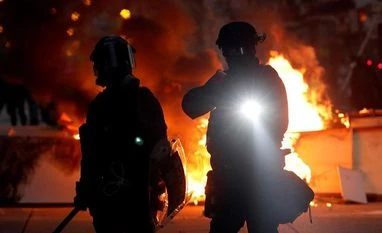
Police officers stand next to a burning barricade during an anti-government protest in Hong Kong. Photo:Reuters
Business Standard Editorial Comment New Delhi
3 min read Last Updated : Nov 29 2019 | 2:00 AM IST
The results of Hong Kong’s district council elections, in which pro-democracy candidates won over 90 per cent of the seats, following prolonged clashes with the authorities since June, have raised a new set of challenges for China’s ruling template of “socialism with Chinese characteristics”. This marks the second time the pro-democracy movement has outwitted Beijing: In September, the authorities withdrew a controversial extradition Bill, which had been the proximate cause for the outbreak of unrest this year, but pro-Beijing Chief Executive Carrie Lam escalated matters by banning the wearing of face masks in public, sparking another round of pro-democracy protests. With Beijing ratcheting up the crackdown by mobilising the military in October, protestors resorted to guerrilla tactics, launching smaller protests in unexpected sites rather than amassing in one place and inviting the kind of massacre that brought the Tiananmen Square protests to an abrupt end in 1989.

For Xi Jinping, who appointed himself President for Life just last year, there are a few guidelines from that crisis, which challenged the authority of Deng Xiaoping, the architect of China’s transformation. In 1989, the US could be little more than an observer. In 2019, the defiance of Hong Kong’s electorate in local elections has been compounded by a sharp rebuke from the United States Congress, which passed with near unanimity two Bills concerning the island territory. One Bill requires Hong Kong’s special trade status with the US to be reviewed annually by the State Department, and threatens sanctions for human rights violations. The other banned the export to the Hong Kong police of crowd-control munitions, such as tear gas, pepper spray, rubber-coated bullets, and stun guns. President Donald Trump signed both into law on Wednesday, adding to long-running tensions with China over trade and intellectual property. Both Bills have consequences for the Special Administrative Region, which gained independence from the UK in 1997. Ever since China opened up its economy to global investment, Hong Kong has been the financial window to the world and a critical trans-shipment hub for export and imports. This unique “one-country-two systems” template has served both territories well. Hong Kong, a founder signatory to the World Trade Organization, has been ranked number one for 24 consecutive years by the Heritage Foundation as the world’s freest economy.

Under a 1992 Act adopted by the US Congress, Hong Kong also enjoys a special status on trade-related matters that recognised the city’s own trade and customs systems rather than China’s. Today, the US runs a $34.5-billion surplus with the territory — the largest bilateral surplus with any country worldwide. Beijing, thus, is caught between the economic realities of Hong Kong’s special status and the political realities of its authoritarian regime on the mainland. A further crackdown may well discourage fledgling political opposition on the mainland (including the restless Xinjiang province), but will have the effect of encouraging global capital to seek competing Asian centres of Singapore and Tokyo. China’s efforts to develop Macao and Shanghai as alternative centres have met with limited success simply because neither has Hong Kong’s unique attributes, which have been honed over centuries. The protests have already had their impact on the economy, with growth expected to contract this year. For the watching world, the face-off between Hong Kong and China will prove a testing-point for the real power of strong governments.

One subscription. Two world-class reads.

Already subscribed? Log in

Subscribe to read the full story →
*Subscribe to Business Standard digital and get complimentary access to The New York Times

Smart Quarterly

₹900

3 Months

₹300/Month

SAVE 25%

Smart Essential

₹2,700

1 Year

₹225/Month

SAVE 46%
*Complimentary New York Times access for the 2nd year will be given after 12 months

Super Saver

₹3,900

2 Years

₹162/Month

Subscribe

Renews automatically, cancel anytime

Here’s what’s included in our digital subscription plans

Exclusive premium stories online

  • Over 30 premium stories daily, handpicked by our editors

Complimentary Access to The New York Times

  • News, Games, Cooking, Audio, Wirecutter & The Athletic

Business Standard Epaper

  • Digital replica of our daily newspaper — with options to read, save, and share

Curated Newsletters

  • Insights on markets, finance, politics, tech, and more delivered to your inbox

Market Analysis & Investment Insights

  • In-depth market analysis & insights with access to The Smart Investor

Archives

  • Repository of articles and publications dating back to 1997

Ad-free Reading

  • Uninterrupted reading experience with no advertisements

Seamless Access Across All Devices

  • Access Business Standard across devices — mobile, tablet, or PC, via web or app

Topics :Donald TrumpHong Kong protestsHong Kong Protesters

Next Story



