Cryptos work because investors believe these have value. That trust is based on the hack proof nature of the blockchain. But what if the blockchain doesn't exist?
premium
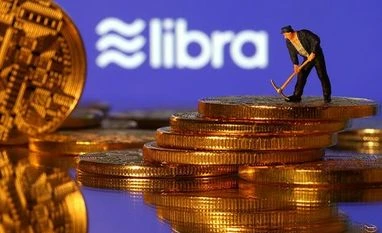
A small toy figure stands on representations of virtual currency in front of the Libra logo in this illustration picture. Photo: Reuters
Facebook's cryptocurrency initiative, Libra, is facing major resistance from regulators and central banks. The social media network has put together an independent foundation that includes some of the most respected names in the global finance industry. But regulators and central banks remain sceptical.
One of the big selling points for the original crypto, Bitcoin, was that it was based on the innovative concept of blockchain. This is an electronic ledger which can be viewed and validated by many people, while being very difficult to “hack”, and offers high levels of anonymity.
Libra also proposes to use a blockchain to validate transactions, albeit one that is only open to foundation members. Unlike Bitcoin, Libra would be a “stable coin” backed by a pool of assets, including fiat currencies and precious metals. It would be run like a currency board, with new Libra, issued against that asset pool at an agreed exchange rate. The Libra could also be redeemed against that pool.
The foundation's members believe that this cryptocurrency would be more efficient than fiat, allowing it to provide services like cross border transfers at lower costs than the existing systems. Facebook's huge user base has the potential to give scale of circulation.
All this may be true and it is indeed possible that Libra would be a beneficial disruptor of the global remittance market. But monumental frauds have been perpetrated by cryptocurrencies that promised similar advantages. Perhaps the most egregious of all crypto frauds is the Bulgarian OneCoin.
OneCoin was launched by a team fronted by the glamourous Dr Ruja Ignatova in 2014. She employed her brother, Konstantin as her PA and he gradually took over a larger role. It's unclear if Ignatova actually has a PhD (or medical degree). She did perpetrate a fraud in Germany as a teenager in tandem with her dad. After receiving a suspended prison sentence, she returned to her native Bulgaria, where she worked with McKinsey for some time. In 2014, she received a national business woman of the year award.
OneCoin claimed it ran on a private blockchain with a “mining" system similar to Bitcoin (only more efficient). It ran an exchange, which let investors convert fiat currencies to OneCoin and back. While the exchange accepted many currencies and issued OneCoin, it only offered euro in exchange for OneCoin (Bulgaria is an EU nation).
Investors were persuaded to enter OneCoin through a variety of marketing ploys.
Ignatova evangelised across the world at glittering investor meets. OneCoin sold “educational kits" for fiat currency payments. The kits explained how cryptos, including OneCoin “worked”. Those kits included tokens that could be exchanged for mined OneCoin. Investors received commissions (mostly in OneCoin tokens) for selling kits, and this was a multi-level commission system. Circular trades on this closed system pushed up the exchange rate from ^0.5 to ^38.
There was no private blockchain in reality. The top layer of the OneCoin pyramid issued OneCoin when they felt like it. This clever hybrid of a crypto-Ponzi scheme is believed to have milked $3.7 billion off investors across many countries before it started to attract serious attention from the police and regulators. It continued to operate and garner revenues even after the exchange stopped operating. Hence, there was no exit option.
Moreover, owners of OneCoin were reluctant to talk to authorities even when they realised they had been defrauded. After all, they were complicit in the Ponzi.
Ignatova disappeared in 2017 when Konstantin became the public face of the company.
He was arrested in the US in March 2019. Several other founders have also been arrested. Authorities in many countries have recovered millions, with China recovering $300 million equivalent. Indian authorities have been investigating the OneCoin since mid-2017 and claim around Rs 75 crore was received by OneCoin in India. But most of that $3.7 billion is not easy to trace.
This case illustrates the dangers of investing in an unregulated cryptocurrency. Cryptos work because investors believe these have value. That trust is based on the hack proof nature of the blockchain. But what if the blockchain doesn't exist? It still works so long as investors believe in its existence!
Read this article for free
Register to continue reading premium journalism and analysis from Business Standard.
Disclaimer: These are personal views of the writer. They do not necessarily reflect the opinion of www.business-standard.com or the Business Standard newspaper

 "The cryptocurrency risk")












 Connect with us on WhatsApp