Concerns have been expressed over some states seeking recourse to excessive borrowing, which no doubt is fiscally imprudent and irresponsible. But how serious are these concerns? And are some states indeed borrowing excessively and living beyond their means?
Data on the debt position of states will tell you a slightly different story. According to a study by the National Institute of Public Finance and Policy, aggregate public debt of 18 major states did go up from 20.53 per cent of gross state domestic product (GSDP) in 2019-20, a pre-Covid year, to 23.5 per cent of GSDP in 2020-21. However, growth in these states’ public debt has slowed down since then. In the revised estimates for 2021-22, the public debt of these states increased marginally to 23.66 per cent of GSDP and is projected at 23.93 per cent in 2022-23.
A close look at the debt position of the individual states is even more revealing. The Fifteenth Finance Commission had indicated a glide path for the states’ debt position in its report of October 2020. According to it, the states should stay below a debt level of 31.1 per cent of GSDP in 2020-21; 30.7 per cent in 2021-22; and 31.3 per cent in 2022-23. By that yardstick, only two states had accumulated debt higher than the stipulated level in 2020-21 — West Bengal at 32.61 per cent and Punjab at 42.17 per cent of GSDP. For the two following years of 2021-22 and 2022-23, the debt level is set to exceed the stipulated level only for two states — Bihar and Punjab.
It would, thus, appear that Punjab has been consistently maintaining a high debt level of over 42-46 per cent of GSDP. Bihar is also a problem state, but its slippage is marginal. Note that apart from these two states, all the other 16 states have stayed within the norms of the Fifteenth Finance Commission. Indeed, the average debt level of these 18 major states is estimated at 23.5 per cent in 2020-21; 23.66 per cent in 2021-22; and 23.93 per cent in 2022-23, which is at least 7-8 percentage points below the level stipulated by the Commission.
It could be argued that the debt numbers for 2022-23 are only the Budget estimates and, therefore, the concerns expressed now could have been caused by the states’ performance during the current year. The borrowing data for the first half of 2022-23 are now available for most of these major states. What they show is that the borrowing of almost all the states is under control — lower than what they had run up in the first half of 2021-22. The problem states once again are Bihar and Punjab, whose borrowing this year is higher than in the same period of 2021-22. Himachal Pradesh has also run up a higher borrowing in the first half of 2022-23.
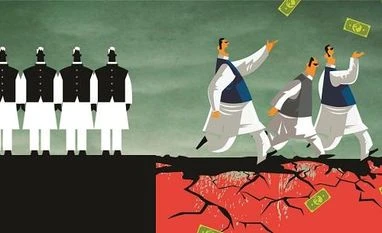
Illustration: Binay Sinha
This could augur well for most of these states’ overall fiscal consolidation plan. In terms of fiscal intentions, at least 10 major states had proposed to reduce their deficit in 2022-23, compared to what they achieved in the previous year. Among them, Bihar and Punjab stood out with a promise of reducing their deficit by a significant margin, while others who also displayed fiscal rectitude were Chhattisgarh, Haryana, Jharkhand, Kerala, Maharashtra, Rajasthan, Tamil Nadu and Uttar Pradesh.
Those who projected a marginal deficit increase in the current year included Andhra Pradesh, Gujarat, Karnataka, Madhya Pradesh, Punjab, West Bengal and Telangana. Two hilly states — Himachal Pradesh and Uttarakhand — had projected a significantly higher fiscal deficit in the current year by over 1 percentage point. Odisha also had projected a higher deficit of about 3 per cent, compared to 0.38 per cent in 2021-22.
It’s not that the states don’t pose any fiscal challenges at all. For instance, in the first six months of 2022-23, Andhra Pradesh and Bihar have already exceeded the full year’s deficit levels. This is largely because their half-yearly tax revenues have been only about a third of what they had projected for the full year. For Bihar, this has been exacerbated by a slower increase in revenues that it had hoped to get from the Centre through the devolution formula.
In contrast, all other states have done exceedingly well in terms of reining in their fiscal deficit and raising tax revenues in the first half of 2022-23. The Centre’s fiscal deficit in the April-September 2022 period was estimated at 37 per cent of the budgeted figure for the full year. But states like Gujarat, Chhattisgarh, Haryana, Karnataka, Madhya Pradesh, Maharashtra, Odisha, Tamil Nadu, Uttar Pradesh and Uttarakhand have reported much lower figures than that. And states like Himachal Pradesh, Kerala, Punjab, Rajasthan, West Bengal and Telangana were well below 50 per cent of their annual budgeted deficit level. This was possible because they had projected reduced borrowing and had secured robust growth in their tax revenues.
So, why are states being accused of excessive borrowing or showing fiscal imprudence? A couple of states have certainly failed to stay within the stipulated debt levels or have shown a streak of fiscal irresponsibility. But as the data show, most of the major states are doing well on both the parameters of their borrowing and tax revenue. Remember that the Centre’s debt level too is hovering around an uncomfortably high level of 60 per cent of gross domestic product (GDP). If the Centre had not increased its reliance on revenue collection from cess and surcharges, the states would have gained even more by way of a higher share in the Union taxes and perhaps their debt problem would have been less severe.
There is, however, one shortcoming in the current state of state finances. None of them has made any conscious effort at increasing their capital expenditure during the first half of the current year. The only two states, which spent more than 40 per cent of their annual capital expenditure budget in the first half of the year, are Kerala and Gujarat. All other states’ capital spend is ranging between 15 per cent (Haryana) and 39 per cent (Madhya Pradesh) of their respective annual capex budgets. The Centre has done well in this area by spending 46 per cent of its annual capex budget in the first half of the year.
The reluctance to spend more could be prompted by their desire to rein in their fiscal deficit. But that problem cannot be solved if the states are accused of having indulged in excessive borrowing, a charge that cannot be established against all of them. The states must spend more, stay fiscally prudent and refrain from excessive borrowing. But the Centre also has a constructive role to play in this area. It could refrain from imposing levies in a manner that keeps revenues outside the divisible pool so that the states do not get any share from such collections. The Centre should also begin a process of consultation with the states. Levelling of charges just won’t do.

 "The state of states: Have they really been fiscally profligate?")











