Abstract art: A collector's delight and solid value for the astute investor

The genre has caught the the fancy of connoisseurs and investors alike. But you need a discerning eye, and plenty of cash and time if you regard the art form as an asset class

Abstract art
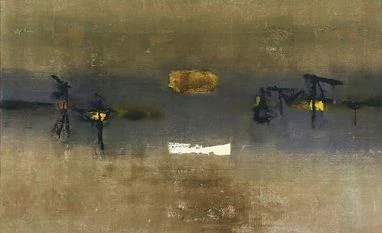
Vasudeo S Gaitonde’s Untitled 1962 oil on canvas. Gaitonde called his work “non-objective” and believed that “there is no such thing as abstract art”
Namrata Kohli New Delhi
7 min read Last Updated : Dec 01 2019 | 9:02 PM IST
A tree is a tree. If you draw one, you merely copy what already exists in nature. Most art is representational, as it invariably has some roots in nature. But there is another form called abstract art, whose proponents assert is the most original, simply because it is "imagery straight out of the human mind". That is how artist Nalini Misra Tyabji describes this form, as I stand gazing at her paintings at the Visual Arts Gallery at Lodhi Road, New Delhi. She calls it the most interesting genre of art, as it gives you total freedom because it comes with no rules whatsoever, and is the kind you can never really copy. Ergo, the possibility of fakes is eliminated.

It is often believed that an appreciator starts off with figuratives and portraits and then veers towards abstracts, virtually making this form the next rung on the evolutionary art ladder. Art curator Kiran Nadar, founder and chairperson of India’s first private art museum, the Kiran Nadar Museum of Art (KNMA), agrees that there may be some truth in that statement, as initially everyone may not relate to the genre. But she says, “This didn’t really happen to me. My eye was quite evolved from the beginning so I was able to appreciate the abstract. But in most people, they do move from figurative to this form.” Nadar says that the best way to train the eye is to get oneself thoroughly exposed to different kinds of art, artists and genres by visiting museums, exploring galleries and developing an understanding of what Indian art is all about.

Oil on canvas by Ram Kumar, 2002. The artist is said to be one of India’s first to give up figurativism for abstract art

Position in the market

The abstract segment, also hailed as “the art of the times”, is high up in the art market and close on the heels of modern and classical forms. Its buyers have increased in number globally from the discerning few and are expected to rise further in future. Gallery owners believe abstracts bring out the best in an artist.

"Globally, abstract art has seen record sales. Just in the previous year, some notable sales were Kazimir Malevich’s Suprematist Composition, Clyfford Still’s PH-399, and Willem de Kooning’s Untitled XXII," says Sharan Seth, Director, Conferro Heritae (Delhi) and Conferro Auctions (London). Malevich’s painting alone accounted for 9.5 per cent of the top auction sales in 2018. 

Seth adds that strong abstract artists have performed well both, internationally and in the Indian art scenario. What makes Indian abstract art even more valuable is its relative rarity. V S Gaitonde, S H Raza and J Swaminathan are the only major names in modern Indian art known for their abstracts. The former two were renowned artists whose works are some of the most prized possessions among collectors. Furthermore, Gaitonde has done very few paintings, while Raza's best period goes back to 1960s and 1970s, when he painted only abstracts. "Gaitonde, the most celebrated modern Indian master, was at the zenith of his artistic prowess when he birthed the most abstract paintings of his oeuvre, abandoning all figurative elements," says Seth. 

Globally, Vincent Van Gogh, Agnes Martin and Norman Lewis are some of the best-selling artists, their oeuvre being largely abstract. Their appeal to collectors and investors is an open secret, for the huge returns they fetch. Their timeless appeal, rarity and multi-dimensional quirks are making abstract paintings the first pick of both artists and connoisseurs. No wonder, emerging artists are increasingly finding refuge in abstraction over other forms in this increasingly volatile world of creative expression.

Sanjay Bhattacharyya’s oeuvre is nostalgic and intense, with scenes of everyday life that are reminiscent of 18th century Dutch art, albeit with an Indian leitmotif. Picture Courtesy: Art Centrix Space


Abstract as a financial asset

Does investment in abstract art yield handsome returns? American artist Andy Warhol once said: “Making money is an art.” But equally, making money from art is an art. Experts believe not every deal will deliver eye-popping returns. In fact, compared to other asset classes, art as a whole suffers from at least five drawbacks as an investment vehicle. Professor, author and art lover Nirmalya Kumar shares some insights on this. "If you suddenly need to sell, it will soon become evident that the art market is not transparent, as no two people agree on what the appropriate valuation is," he says. 

Moreover, art is an illiquid asset. The Indian art market is especially shallow with relatively few buyers. Thirdly, high transaction costs at the auctions can eat up as much as 30 per cent of the deal value. Compare this with the small brokerage one pays for buying or selling shares on the stock exchange. What's more, unlike property, stocks and bonds, an investment in art doesn't bring with it income in the form of rentals, dividends, or interest. Instead, the owner usually ends up paying for storage and insurance. 

Kumar does some arithmetic and says that the real annual returns (subtracting inflation from nominal returns) from paintings reported in empirical studies range from 0.6 per cent to 5 per cent, with a median return of 2.6 per cent. The Mei and Moses study is most popular with art professionals because its estimate of the annual real return from art investments is the highest, at 4.9 per cent per annum between 1875 to 2000. But even this figure falls quite short of the returns delivered by equities (S&P 500 or the Dow Jones Industrial Average).  

Vis-à-vis bonds, the story is slightly more complex, as art underperforms corporate bonds and only slightly outperforms the relatively risk-free US government bonds. And, by the way, the results are even worse for masterpieces, going against conventional wisdom, which argues that buying the best and most famous works yields the highest returns.

Despite the underperformance, it could be argued that art could be included in one's investment portfolio if it has lower volatility or isn't correlated with equities. The news on both these fronts is not encouraging. The volatility of art as measured by the variance of returns is at least twice that of equities or corporate bonds. And art indices typically have a positive correlation with equities and negative correlation with bonds or treasury bills. In financial theory, this means that an art index plays second fiddle to other asset classes in a portfolio that seeks to maximise returns and minimise variance.

However, a lot depends on the age of artist, the gallery promoting him, the type of art form, art fairs to which the artist has been invited, and so on. Take the case of Hurun Art Foundation, which was established five years back to collect art and promote artists. "Some of the pieces could possibly get you better returns than the stock markets," says Anas Rahman Junaid, Managing Director and Chief Researcher, Hurun Report India. For instance, based on available auction prices, $100 invested in a work by Sayed Haider Raza in 2000 would be worth an average of $864 (up a staggering 764 per cent) in November 2019. 

You, too, can make a fortune dealing in abstract art. All you need is an eye for important, beautiful pieces, some spare cash and a time machine.

Artist 2018 turnover* Sold lots Best result* Lifetime best Hammer Price*
Sayed Haider Raza (1922-2016) 16,207,457 106 4,452,500 Tapovan (1972) 3,700,000
Vasudeo S Gaitonde (1924-2001) 8,285,516 13 2,152,803 Untitled (1995) 3,809,700
Ram Kumar (1924-2018) 3,594,066 59 803,596 Vagabond (1956) 1,000,000#
Zarina (1937-) 409,275 18 72,600 Home is a Foreign Place (1999) 145,260
Gulam Rasool Santosh (1929-1997) 394,645 18 144,240 Aspiration (1957) 125,426
Sujata Bajaj (1958-) 366,096 12 95,729 Ganesha 83,243
Biren De (1926-2011) 286,244 7 77,294 Untitled (1983) 70,000
Natvar P Bhavsar 77,005 9 Not available K-NRA (1973) 35,714
Ganesh Haloi (1936-) 60,980 5 18,505 Untitled 50,000
Rajendra Dhawan 51,298 9 Not available Repetitive Breathing (1969) 29,751
Prabhakar Kolte
14,588 5 Not available Untitled (2003) 35,000 Sohan Qadri (1932-2011) 45,061 6 15,191 Chandigarh 54,421 * Figures in US dollars; # Estimated; Source: Hurun Report and ArtPrice

One subscription. Two world-class reads.

Already subscribed? Log in

Subscribe to read the full story →
*Subscribe to Business Standard digital and get complimentary access to The New York Times

Smart Quarterly

₹900

3 Months

₹300/Month

SAVE 25%

Smart Essential

₹2,700

1 Year

₹225/Month

SAVE 46%
*Complimentary New York Times access for the 2nd year will be given after 12 months

Super Saver

₹3,900

2 Years

₹162/Month

Subscribe

Renews automatically, cancel anytime

Here’s what’s included in our digital subscription plans

Exclusive premium stories online

  • Over 30 premium stories daily, handpicked by our editors

Complimentary Access to The New York Times

  • News, Games, Cooking, Audio, Wirecutter & The Athletic

Business Standard Epaper

  • Digital replica of our daily newspaper — with options to read, save, and share

Curated Newsletters

  • Insights on markets, finance, politics, tech, and more delivered to your inbox

Market Analysis & Investment Insights

  • In-depth market analysis & insights with access to The Smart Investor

Archives

  • Repository of articles and publications dating back to 1997

Ad-free Reading

  • Uninterrupted reading experience with no advertisements

Seamless Access Across All Devices

  • Access Business Standard across devices — mobile, tablet, or PC, via web or app

Topics :art collection

Next Story