Buy into international funds when Indian equity returns run dry

Apart from sustaining your portfolio when the domestic market is faring well, global diversification also safeguards it against currency risk
graph
Sanjay Kumar Singh
Last Updated : Mar 19 2018 | 10:50 PM IST
At a time when the trailing three-month return for most equity fund categories have turned negative, one category that is still in the positive is international funds (return 4.22 per cent; source: Value Research), underlining the ability of these funds to act as portfolio diversifiers. 

Like most investors globally, Indian investors too have a home bias. The bulk of their portfolio is invested in India and they are often reluctant to invest abroad. The home bias tends to get more pronounced when the Indian markets are doing well. According to experts, however, having a 10-20 per cent (of the equity portfolio) exposure to international funds can make your investment journey smoother by counterbalancing the underperformance in Indian markets. 

Various equity markets perform at different points of time. In 2011, for instance, the Indian market was down in the dumps, with the Nifty giving a return of -24.90 per cent. That year the S&P 500 (the US index) fell only -1.12 per cent. By investing in international markets with which the Indian market has a low correlation, (the US is an example), an Indian investor can make his portfolio more stable. "Investing in international funds adds geographical diversification to your portfolio, just as you get asset class diversification by investing in large-cap, mid-cap, bond funds, etc. This reduces concentration risk as different markets don't always move in tandem," says Nikhil Banerjee, co-founder, Mintwalk.

International diversification also helps to safeguard the portfolio against currency risk. Over the long term, the Indian rupee tends to depreciate against major global currencies such as the US dollar. In future, most affluent Indians will have financial goals that have to be funded in the dollar. These could include children's higher education, foreign travel, etc. Having a part of your portfolio invested in a foreign currency denominated fund will help you guard against the risk of rupee depreciation.


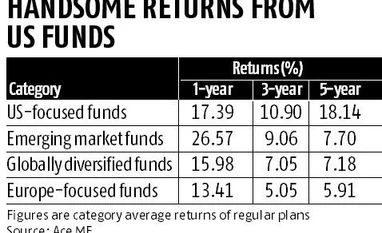
Since one of the major motives for investing in an international fund is diversification of country risk, the first category of funds you should invest in is a US fund. While the US market does not have a negative correlation with the Indian market, the level of correlation is relatively low. Moreover, the US is the biggest equity market by market capitalisation. 
 
Many of the stocks listed there are of multinationals, which earn their revenues and profits across the globe. An investment in a US fund, thus, also amounts to global diversification. By investing in the US market, you can also gain exposure to sectors to which you don't get exposure in the Indian market, such as defence equipment manufacturers, global e-tailers, and so on.

One subscription. Two world-class reads.

Already subscribed? Log in

Subscribe to read the full story →
*Subscribe to Business Standard digital and get complimentary access to The New York Times

Smart Quarterly

₹900

3 Months

₹300/Month

SAVE 25%

Smart Essential

₹2,700

1 Year

₹225/Month

SAVE 46%
*Complimentary New York Times access for the 2nd year will be given after 12 months

Super Saver

₹3,900

2 Years

₹162/Month

Subscribe

Renews automatically, cancel anytime

Here’s what’s included in our digital subscription plans

Exclusive premium stories online

  • Over 30 premium stories daily, handpicked by our editors

Complimentary Access to The New York Times

  • News, Games, Cooking, Audio, Wirecutter & The Athletic

Business Standard Epaper

  • Digital replica of our daily newspaper — with options to read, save, and share

Curated Newsletters

  • Insights on markets, finance, politics, tech, and more delivered to your inbox

Market Analysis & Investment Insights

  • In-depth market analysis & insights with access to The Smart Investor

Archives

  • Repository of articles and publications dating back to 1997

Ad-free Reading

  • Uninterrupted reading experience with no advertisements

Seamless Access Across All Devices

  • Access Business Standard across devices — mobile, tablet, or PC, via web or app

Next Story



