“With a puff of hukka and a tiff with its Jirga the tribe turns to the wisdom of aging woman. Yet the uncertainty of “youth” keeps revolving.” These words are handwritten by M F Husain at the end of a limited edition of 300-odd prints he himself commissioned, and it comes with his famous signature. Likewise, S H Raza had got a hundred special prints of his famous bindu dot series titled ‘kundalini’ printed in France.
This is the best alternative to original art and it falls totally within the realm of ethics and legality, says Gurugram-based art gallery owner Mannu Dosaj, founder Gallerie Alternatives. Prints come at a fraction of a price of the original and with prices ranging from a few thousands to a few lakhs. For instance, you can have a Raja Ravi Verma print for as little as Rs 5,000, while a Husain print can start at Rs 35,000 onwards and a Raza bestseller is Rs 1.5 lakh. The price is based on the size of the print, the quality of printing, and value is also attached to exactly who is printing it. Master printers like Laxmi Goud and Asim Pal have their own fan following.
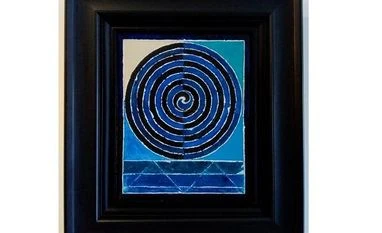
An original S H Raza piece from the artist's Kundalini series. The painting is available for Rs 25 lakh
So, what exactly are prints?
They are typically photographs taken of the artwork and printed. Within this market of replicas, there are various types. There is printing done on a zinc plate with a fine needle, on aluminium plates, on wood, and then there are graphic prints, etching, intaglio and such like. There are lithographs and serigraphs that offer art collectors the opportunity to collect the works of their favourite artists at a fraction of the cost. A fine art print (like a serigraph) will always have value and, in fact, fine quality prints made by leading printmaking artists sell for thousands to a few lakhs of rupees.
However one should never buy an imitation as it’s a huge disrespect to the journey of an artist and his experience, says Dosaj. Art collector Timmie Kumar who is co-founder Ta blu Café Bar and Art Gallery seconds this. “I feel it is better to buy the print of an original artist which is legally acceptable rather than buying imitation art which undermines the creator's work. I know there is a huge price difference between original and imitation, maybe up to or even more than roughly 10x.” Original-versus-fake has always been an issue in the art world. According to Anubhav Nath, curatorial Director, Ojas Art, “Fake-versus-original is an ongoing problem. Best would be to acquire from reputed galleries and make sure that you have the authenticity documents in place. Authenticity documents mainly consist of the authenticity certificate issued by the gallery or artist, invoice and any publication history for the artwork.”
This limited edition print on canvas, commissioned by S H Raza himself, costs Rs 1.5 lakh
Prints aren't always showcased at home. There are a number of collectors who’ve acquired limited editions for their offices as well, informs Vijaymohan, “to be placed in mid-management chambers, and in corridors, and floor lobbies. There has definitely been a rise in the interest in this medium and it usually is from collectors who are intent on acquiring a work by a favourite artist whose pricing they are certain has now risen beyond their reach.”
He adds that they do not witness frequent instances of “fake prints”, since their valuation is relatively low, though there are occasionally a few that will be offered in the secondary markets.
Well, yes they do, but one has to have patience. Dosaj shares how a Raza print that cost Rs 50,000 some 15 years ago is now worth nothing less than Rs 1.5 lakh. They do witness a rise in pricing, but it depends on the artist, subject, size and importantly, on the edition size as the lower the number, the stronger is its potential of future rise in valuation.
However, good quality replicas of Indian art are few and far between. According to Professor, author and art lover Nirmalya Kumar, “Very few major Indian artists did any authorised and numbered editions. But this must develop with the contemporary Indian artists.” He shares three ways to judge the genuineness of a piece of work – technical analysis, eye, and provenance. None of them is foolproof and one uses triangulation of methods. For different artists, the weightage placed on each of these three factors differs.

 "Take heart, investments in art needn't burn a hole in your pocket")











