Akharas or VHP? Govt faces temple 'trust' issue, would need a balancing act

The Centre would need to accomplish a balancing act in accommodating the interests of the akharas, as well as that of the VHP
ayodhya
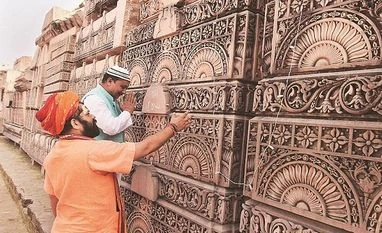
Senior priest Mahant Raju Das of Hanuman Garhi Mandir and Muslim leader Babloo Khan at Ram Janmabhoomi Nyas in Ayodhya on Sunday Photo: PTI
Archis Mohan
4 min read Last Updated : Nov 10 2019 | 10:07 PM IST
By ordering the Centre to set up a trust for the construction of a temple at the Ram Janmabhoomi in Ayodhya, the Supreme Court has limited the role the Sangh Parivar, especially the Vishva Hindu Parishad (VHP), had hoped to play in that process.

While the apex court rejected the claim of Nirmohi Akhara, it asked the Centre to accommodate it in the soon-to-be set up trust. This has enthused saints to put forth their demand that the proposed trust should primarily comprise the 13 akharas of Hanumangarhi temple and other temples of Ayodhya.

The Centre would need to accomplish a balancing act in accommodating the interests of the akharas, as well as that of the VHP. The precedents of temple trusts available with the Centre are the Shri Mata Vaishno Devi Shrine Board and the Shri Somnath Trust.

The sadhu samaj has reminded the government of the decision taken in its all India conference on December 29, 2017, when it said the descendants of the late Baba Abhiram Das should be the priests of the new temple. They said Das had placed the idols in 1949, and “external parties” not part of the sadhu samaj of Ayodhya should have little role and be denied the responsibilities of a pujari in the soon to be constructed temple.

The Supreme Court has asked the Centre to set up a trust within three months. According to sources, the Union culture and law ministries will have consultations over the next week, in the run-up to the winter session of Parliament that begins on November 18, to draft a Bill for setting up the trust.

The Somnath temple trust is a religious charitable trust registered under the Gujarat Public Trust Act, 1950. The Vaishno Devi Shrine Board runs the temple in Jammu. It was set up in 1988 through an Act of the now erstwhile Jammu and Kashmir Assembly. The Shri Amarnathji Shrine Board is also based on the Vaishno Devi Shrine Act.

The governor of Jammu and Kashmir is the ex-officio chairman of the Vaishno Devi shrine board and nominates nine members to the board. According to the Act, these are two persons who have distinguished themselves in the service of the Hindu religion, two women who have worked in the service of Hindu religion, or done social work, three persons with experience in administration, legal affairs and financial matters, and two eminent Hindus of J&K. The members have a term of three years. The current members of the board include Sri Sri Ravi Shankar, a former judge, retired bureaucrats, etc.

The board discharges its duty through a chief executive officer, currently an officer of the Indian Administrative Service, and other functional heads. Its income comes from donations by devotees and interest accrued from deposits and dividends, and it carries out the development and maintenance work of the temple.

The Somnath trust, however, is entirely dominated by politicians. Currently, Prime Minister Narendra Modi, Home Minister Amit Shah, senior BJP leader L K Advani and former Gujarat Chief Minister Keshubhai Patel are part of the eight-member board of trustees, which also includes a chairman and a secretary. Board of trustees are elected for life but can be removed.

The Somnath trust manages the Somnath temple, 64 other temples in Prabhas Patan, its guesthouses, and the 2,000 acres it owns. The trust does not give any share of its temple revenue to the government and has in the recent past issued public notices asking non-Hindus to seek permission from the general manager of the temple before entering the main structure.

The first Home Minister of India Sardar Vallabhbhai Patel was the moving force behind the reconstruction of the temple. While then Prime Minister Jawaharlal Nehru was not keen that public money be spent on constructing the temple, Patel and educationist K M Munish raised the money from through public subscriptions, including from industrialists like G D Birla, who was a member of the first board of trustees. Advani had started his Rath Yatra in 1990 from the Somnath temple.


One subscription. Two world-class reads.

Already subscribed? Log in

Subscribe to read the full story →
*Subscribe to Business Standard digital and get complimentary access to The New York Times

Smart Quarterly

₹900

3 Months

₹300/Month

SAVE 25%

Smart Essential

₹2,700

1 Year

₹225/Month

SAVE 46%
*Complimentary New York Times access for the 2nd year will be given after 12 months

Super Saver

₹3,900

2 Years

₹162/Month

Subscribe

Renews automatically, cancel anytime

Here’s what’s included in our digital subscription plans

Exclusive premium stories online

  • Over 30 premium stories daily, handpicked by our editors

Complimentary Access to The New York Times

  • News, Games, Cooking, Audio, Wirecutter & The Athletic

Business Standard Epaper

  • Digital replica of our daily newspaper — with options to read, save, and share

Curated Newsletters

  • Insights on markets, finance, politics, tech, and more delivered to your inbox

Market Analysis & Investment Insights

  • In-depth market analysis & insights with access to The Smart Investor

Archives

  • Repository of articles and publications dating back to 1997

Ad-free Reading

  • Uninterrupted reading experience with no advertisements

Seamless Access Across All Devices

  • Access Business Standard across devices — mobile, tablet, or PC, via web or app

Topics :Ayodhya caseAyodhyaVishva Hindu ParishadRam Janmabhoomi dispute

Next Story



