In New York, gloom and failure
Singh left for the US in a blaze of optimism. The trip ends with an unrelieved gloom
Mihir S Sharma New York
A sense of uncertainty hung over the meeting between Nawaz Sharif and Manmohan Singh – what, precisely, could Sharif credibly promise? What would he want to? It was only enhanced when, apparently, he gave an interview to NDTV. Trouble came not from his interview but from apparently distorted third-hand reports of what he actually said – according to one Pakistani journalist, Sharif called Singh a “dehati aurat”, or rural woman.
That’s less an insult and more a non sequitur even if true. The truth eventually came out: Sharif, who imagines himself a bit of a raconteur, told a lengthy story about a rural woman who keeps on running to a local maulvi to solve all her problems with her neighbours. The punchline, essentially, was that the rural woman should try to solve her problems herself; the woman, thus, being India, and the maulvi being the US. Oddly, nobody in the US electronic media thought Sharif had insulted Barack Obama.
The inability of some in India to understand an allegory led to this fairly mild interaction blowing up in Sharif’s and Singh’s faces. Sharif’s people, already nervous and hoping for some concessions to strengthen his hands with the army, were extremely distressed. In the Indian delegations in New York, more people seemed interested in the odd reversal in which Pakistan was arguing against internationalising complaints – remember, this from Sharif, who ended the Kargil war only after he flew to Washington and claimed an assurance from Bill Clinton – but back in India, the story seemed different.
And, certainly, it changed completely overnight. Another night in this sleepless trip was interrupted when news broke that Gujarat Chief Minister Narendra Modi, addressing a rally in New Delhi, announced in his inimitable style that he had differences but great respect for Manmohan Singh — a fact not previously widely reported — but, sadly, that the Congress had very little; and, thanks to that, neither did Sharif, or whoever from the media who overheard Sharif’s supposed insults to Singh while eating Sharif’s sweets.
This startling declaration led to many in the media delegation, at least, wearing the mildly poleaxed look that journalists have when they are forcefully reminded how easily, in today’s world, they themselves can become the main story. But, more to the point, it seemed to have further destabilised the Prime Minister’s Office’s preparation for the Sharif bilateral. One official said a major agreement was made even more difficult now that any concession to Sharif by India could be attacked by his political opponents, including Modi, as born only of weakness. Another said Sharif, already unwilling to declare anything for fear it would become a casualty of Indian domestic politics, would be even less enthusiastic about it now.
Like Rahul Gandhi’s statement a few days ago, Modi’s on Saturday cast a fresh pall of gloom over the talks. The uncertainty only thickened. The body language, said those inside the room, was visibly uncomfortable, though both leaders have separately said they need some breakthrough to happen.
And, eventually, no breakthrough was made. Quite the reverse: The meeting underlined the fact that Indo-Pakistan relations have in fact gone backward. The consensus was that hammer blows been delivered at Singh on this eventful trip – by a terrorist attack in Jammu, by Gandhi, by Modi – as well as the consistent criticism of Singh’s approach to Pakistan in the Indian electronic media, had destroyed the chance of a quicker normalisation of relations. The National Security Advisor, in his briefing, afterwards, looked dispirited instead of optimistic, and his primary concern seemed to be to avoid any kind of headline. “There are no awkward questions, only awkward answers,” he said, “and you’ll get none of those here”.
Singh left for the US in a blaze of optimism. The trip ends with an unrelieved gloom. And, in New York at least, there is little doubt it is not Singh’s fault that this is so.

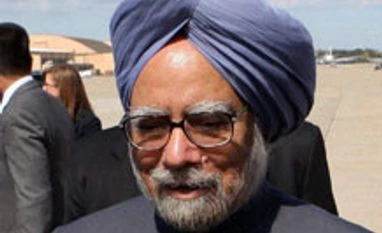 "In New York, gloom and failure")


 Connect with us on WhatsApp