
Lok Sabha remains paralysed for ninth day, but two bills passed amid din
Opposition members gathered near the Speaker's podium and kept protesting while the bills were passed
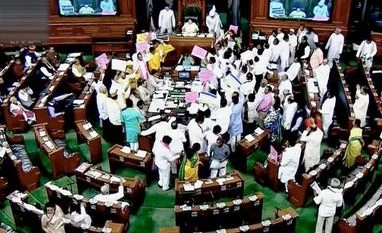 "Lok Sabha remains paralysed for ninth day, but two bills passed amid din")
WebinarsNew
Deep DiveNew
Explore Business Standard
Opposition members gathered near the Speaker's podium and kept protesting while the bills were passed
Two bills were passed amid din in the Lok Sabha on Thursday, as members from different parties crowded near the Speaker's podium, showing placards and raising slogans over different issues.
Minister of State for Labour, Santosh Kumar Gangwar moved The Payment of Gratuity (Amendment) Bill, 2017, which was passed through a voice vote in the din.
The government then moved The Specific Relief (Amendment) Bill, 2017, which was also passed amid din through a voice vote.
As Meghwal moved the bill on payment of gratuity, Speaker Sumitra Mahajan said she agreed that the bill should have been discussed, but added that it was important to pass it.
"I agree that a discussion should have been there. But it is not possible and it is important to pass the bill..." the Speaker said as Congress members shouted "no" in chorus.
The amendments moved by Revolutionary Socialist Party member N K Premachandran and Congress' Adhir Ranjan Chowdhury were also negated by voice vote while the government amendments were accepted.
The Payment of Gratuity Act, 1972 allows for the payment of gratuity to employees in any establishment, factory, mine, oilfield, plantation, port, railways, company, or shop employing 10 or more workers.
Employees are paid gratuity if they have provided at least five years of continuous service at the time of termination.
This Bill empowers the central government to notify the period of maternity leave eligible for qualifying as continuous service; and determine the amount of gratuity available to employees.
The maximum maternity leave, for the purpose of calculating continuous service under the Act, was based on the maternity leave provided under the Maternity Benefit Act, 1961.
The maximum maternity leave under the 1961 Act was changed from 12 weeks to 26 weeks by the Maternity Benefit (Amendment) Act, 2017. The Bill removes the reference to 12 weeks in the 1972 Act and empowers the central government to notify the maximum maternity leave.
Under the Act, the maximum amount of gratuity payable to an employee cannot exceed Rs 10 lakh. The Bill removes the existing ceiling and states that the ceiling may be notified by the central government.
Under The Specific Relief Amendment Bill, certain civil courts may be designated as Special Courts by the state government, in consultation with the Chief Justice of a High Court.
These courts will deal with cases related to infrastructure projects. Such cases must be disposed off within 12 months from the date of receipt of summons by the defendant. This period can be extended by the courts for another six months.
Members from the Congress, Trinamool Congress, Telugu Desam Party, YSR Congress and the Telangana Rashtra Samithi gathered near the Speaker's podium and kept protesting while the bills were passed.
The Lok Sabha has been witnessing protests over a host of issues including banking irregularities, the PNB fraud, special economic status for Andhra Pradesh and management of Cauvery water.
Amid protests, the Speaker adjourned the House for the day.
First Published: Mar 15 2018 | 3:56 PM IST

