Political parties are split on the introduction of a new machine which prevents disclosure of voting pattern during counting to enhance secrecy, the Election Commission has informed the Law Ministry.
The Commission's letter to the Legislative Department in the Law Ministry is now part of documents before a team of ministers formed last month to take a call on whether the machine should be used in future elections.
While it is learnt that the team of ministers is in favour of the 'totaliser' machine, a final decision will be taken by the Union Cabinet based on its recommendations.
The five-member team headed by Home Minister Rajnath Singh, was set up on the directions of the Prime Minister's Office, to recommend to the Union Cabinet on whether the machines can be used.
The move of the government to set up a team of ministers comes against the backdrop of the Supreme Court asking the Centre to decide on the issue by this month end.
The machine is connected to control unit of EVMs after polling and it gives out an overall result. It does not disclose results boothwise, thus preventing parties from knowing which area voted against them. When EVMs were not in use, ballot papers from different booths were mixed before counting to conceal voting pattern.
According to the Commission, Congress, NCP and BSP "categorically" supported its proposal to use 'totaliser' machines, while the ruling BJP was of the view that booth-wise performance is important for parties in their booth management.
"The CPI-M agreed in principle to the proposal with the rider that we should be careful regarding the fool-proof functioning of the totaliser and that in may be tried out in phases," the Commission has told the Law Ministry.
Referring to a meeting convened by it of recognised national and state parties in March to discuss electoral reforms, including the use of totalisers, the Commission has informed the ministry that the CPI did not give any specific view on the use of the new machine.
While AAP -- Delhi's only recognised state party -- has supported totaliser, Trinamool Congress -- accorded national party status last week -- opposed its introduction.
The other members of the team of ministers include
Finance Minister Arun Jaitley, Defence Minister Manohar Parrikar, Transport Minister Nitin Gadkari and Law Minister Ravi Shankar Prasad.
The Election Commission had in 2008 proposed to use 'totaliser', which prevents disclosure of voting pattern during counting to enhance voter secrecy, and has received the backing of the Law Commission.
The issue was pending with the government. On August 5, a Supreme Court bench, while hearing a writ petition, gave the Centre eight weeks time to take a "final decision" on the issue and post the matter for further hearing in February, 2017.
"The writ petition has been coming up for hearing during the last two years in the Supreme Court, and the court has been pushing hard for taking a view in the matter at the earliest," a Law Ministry note on the issue said.
The Law Ministry is the administrative ministry for the poll body.
The poll panel is of the view that with the use of totaliser, a further level of secrecy in voting and the mixing of votes at the time of counting will be achieved. It said the machine will prevent the disclosure of pattern of voting at a particular polling station.
The law panel, in its report on electoral reforms submitted to the Supreme Court on March 10, 2015 had supported the use of the new machine.
It has recommended amendment to the Conduct of Election Rules to give EC powers to use totaliser for mixing of votes where it apprehends intimidation and victimisation of electors in a constituency.
The Law Ministry is of the view that no electoral law will have be amended to introduce totalisers. Amending the Conduct of Election Rules, 1961 "would suffice".
The rationale behind EC's proposal was that the current system revealed the voting trends in each polling station, thus leaving the voters in that vicinity open to harassment, intimidation and post-election victimisation.
"Prior to the introduction of EVMs, ballot papers could be mixed, wherever it was considered absolutely necessary under the Conduct of Election Rules in light of apprehended intimidation and victimisation of electors. However, EVMs do not permit this," the law panel noted in its report.

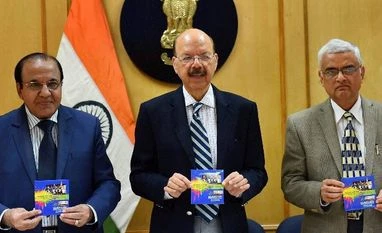 "Parties differ on machine that hides voting pattern: Election Commission")


 Connect with us on WhatsApp