Home / World News / Rescue teams battle severe weather as they search for missing Iranian plane
Rescue teams battle severe weather as they search for missing Iranian plane
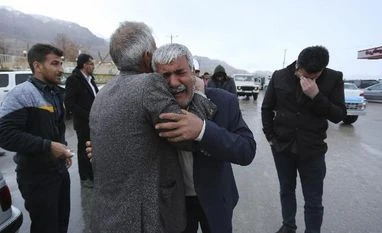
Families of the passengers had travelled to the area and were giving DNA samples for later identification of victims
: In this photo provided by Tasnim News Agency, family members of a plane crash victims weep in the village of Bideh, at the area that the plane crashed, southern Iran | Photo: AP/PTI
Iranian rescue teams battled severe weather Monday as they searched for the wreckage of a passenger plane that disappeared high in the Zagros mountains the previous day with 66 people on board.
Several helicopters that had deployed at dawn to hunt for Aseman Airlines flight EP3704 were forced to return to base, officials said.
"Unfortunately due to strong winds and fog reducing visibility, it was not possible for helicopters to continue their search," a Red Crescent official told the ISNA news agency.
Officials said hundreds of mountaineers, supported by dogs and drones, were operating around the 14,465-foot (4,409-metre) Dena mountain, which is popular with Iranians seeking to prepare for climbing in the Himalayas.
The ATR-72 twin-engine plane, in service since 1993, flew early Sunday from Mehrabad airport towards the city of Yasuj, some 500 kilometres to the south.
The planes emergency locator transmitter was reportedly not functioning, helping to explain the difficulty in finding the wreckage.
Families of the passengers had travelled to the area and were giving DNA samples for later identification of victims, the IRNA news agency reported.
A team of crash investigators from French air safety agency BEA was set to arrive in Iran later on Monday.
An ATR-72 crashed in similar icy conditions in Indiana in the United States in 1994, leading some operators to avoid cold weather conditions.
"It is a very safe aircraft but... operators decided not to use it in cold mountain areas in the US," said Iranian aviation expert Babak Taghvaee.
"Even newer versions of this aircraft are not good for such cold places and it would be better not to use it for this route and especially with such bad weather and visibility," he said.
Aseman Airlines was blacklisted by the European Commission in December 2016.
It was one of only three airlines barred over safety concerns -- the other 190 were blacklisted due to broader concerns over oversight in their respective countries.
Iran has complained that sanctions imposed by the United States have jeopardised the safety of its airlines, making it difficult to maintain and modernise ageing fleets.
Aseman was forced to ground many of its planes at the height of sanctions due to difficulties in obtaining spares, Taghvaee said.
In a working paper presented to the United Nations International Civil Aviation Organization (ICAO) in 2013, Iran said US sanctions were barring "the acquisition of parts, services and support essential to aviation safety".
Iran has suffered multiple aviation disasters, most recently in 2014 when 39 people were killed as a Sepahan Airlines plane crashed just after take-off from Tehran, narrowly avoiding many more deaths when it plummeted near a busy market.
But figures from the Flight Safety Foundation, a US-based NGO, suggest Iran is nonetheless above-average in implementing ICAO safety standards.
Lifting sanctions on aviation purchases was a key clause in the nuclear deal Iran signed with world powers in 2015.
Following the deal, Aseman Airlines finalised an agreement to buy 30 Boeing 737 MAX jets for USD 3 billion (2.4 billion euros) last June, with an option to buy 30 more.

 "Rescue teams battle severe weather as they search for missing Iranian plane")


 Connect with us on WhatsApp