Centralised voter management system to eliminate distortions: Nilekani
He has made these suggestions in the book titled 'Rebooting India - Realizing a billion aspirations'
Press Trust of India New Delhi Putting in place a centralised voter management system can help eliminate distortions arising out of the political economy that has muddied voter registrations, says a new book co-authored by technocrat Nandan Nilekani.
In the book penned by him and his UIDAI colleague Viral Shah, they have also pitched for widespread adoption of electronic payment systems.
The suggestions have been made in the book titled 'Rebooting India - Realizing a billion aspirations'.
Nilekani, who himself fought the 2014 general elections, is the Founding Chairman of the Unique Identification Authority of India (UIDAI) and co-founder of Infosys.
According to Nilekani and Shah, when bank account and mobile phone connection can move with a person from one city to another, it is only fair to expect that a voter ID should be able to do so as well.
"By imposing geographical constraints on the ability to vote, we are in effect denying people their fundamental right as citizens of a representative democracy. To address these issues, we propose the creation of a centralised voter management system, " the book said.
With a single, centralised voter enrolment system running the same multilingual software across the country, the duo said there would be no incentive for "distortions, biases and fraud, eliminating the entire political economy that has muddied voter registration".
When there is already a centralised system capable of storing Aadhaar data of 1.2 billion Indians, there is no reason why a similar system can't be build for voter ID data, they wondered.
According to the duo, the only way to bridge the last mile gap will be through the widespread adoption of electronic payment systems.
The government must be the initial driver, using the heft and reach of its social security schemes to drive the adoption of an electronic payments model, they noted.
"We envision electronic payments as the first step on the ladder of financial inclusion," Nilekani and Shah have said.
As per the book, the country's problems need to be fixed at a great speed, at scale, with high quality while providing solutions that are easy to access, independent of geography and low-cost.
"Technology, the great leveller, is our only hope of meeting these goals," it said.

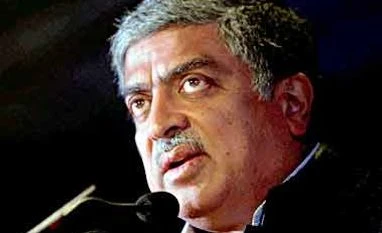 "Centralised voter management system to eliminate distortions: Nilekani")


 Connect with us on WhatsApp