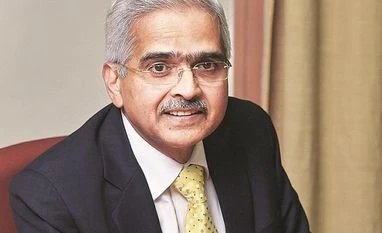
RBI Governor Shaktikanta Das on Thursday said the Rs 1-lakh-crore of long-term repos are aimed at helping banks lower their lending rates, thus quickening the monetary policy transmission.
At the sixth bi-monthly policy announcement, where the policy rates were left unchanged, the Reserve Bank announced long-term repurchase agreements (repos) of one-year and three-year tenors of appropriate sizes, totalling Rs 1 lakh crore at the policy repo rate, from the fortnight beginning on February 15.
The monetary policy committee unanimously left the repo rate unchanged at 5.15 per cent but maintained an accommodative policy stance at the sixth meeting of the year.
It can be noted that the longest repo that the RBI has so far done is of 56 days, while most of its either overnight or for a fortnight. And given this, the one-year and three-year repos are a new beginning for the monetary authority's effort to contain cost of money.
"It is an effort to ensure better monetary policy transmission because we are giving the funds at the policy rate. We want to inject Rs 1 lakh crore into the banking system that will enable banks to reduce their lending rates," Das told reporters in the post policy conference.
It can be noted that given the very tepid demand for fresh loans, the banking system is flushed with over Rs 2.5 lakh in surplus liquidity. Average credit growth till the last fortnight of January was a low 7.21 per cent.
The governor further said the process of monetary policy transmission quickens when the banks get cheaper funds.
The newly-appointed deputy governor Michael Patra, however, clarified that the long-term repos will not replace open market operations.
"The long-term repo operations are not intended to replace the OMOs. The idea is to help banks reduce the cost of funds. It also gives some assurance of durable liquidity," Patra said.
Explaining further, Deputy Governor N S Vishwanathan said at present banks are just borrowing overnight and it comes back to the RBI into the overnight reverse repo.
"We want banks to borrow for longer-term which will again move in the form of lending. We want banks to lend rather than come back to us in the form of overnight reverse repos," Vishwanathan said.
In four straight reductions since the beginning of last February, the RBI has cumulatively cut the repo rate by 135 bps to a nine-year low of 5.15 per cent.
As against the reduction of 135 bps, transmission to various money and corporate debt market segments up to January 31, 2020 ranges from 146 bps to 190 bps, while banks' lending has been a far cry of this at around 40 bps reduction.
The weighted average lending rate on fresh rupee loans sanctioned by banks declined by 69 bps and the same on outstanding rupee loans by 13 bps during February-December 2019, the RBI said.
Since June 2019, the RBI has ensured that comfortable liquidity is available in the system to facilitate faster transmission and flow of credit to the economy. But ironically, there is no demand for large loans given the tattered economy.
These efforts are being carried forward with a view to assuring banks about the availability of durable liquidity at reasonable cost relative to prevailing market conditions.
"This should encourage banks to undertake maturity transformation smoothly and seamlessly so as to augment credit flows to productive sectors," the RBI said in its statement on developmental and regulatory policies.
Talking about the special OMOs or the operation twist, the governor said it is an instrument to ensure better monetary policy transmission.
Between December and January, 2020, the RBI conducted four simultaneous purchase and sale of government securities under open market operations.
"As you know that corporate bonds are benchmarked to the lending rates in the government securities segment. By operation twist, if you are able to soften the yields on government securities at longer end, say at 10-year government securities, then that acts as a benchmark for the corporate bond rates," he said.
"So, the effort is mainly to ensure better policy transmission to the corporate bond market and not so much to manage the yield on gsecs," Das said.

 "Long-term repos aimed at helping banks cut lending rates: Shaktikanta Das")


 Connect with us on WhatsApp