Reserve Bank of India (RBI) Governor Raghuram Rajan on Thursday said there was no reason for the central bank to manage public debt and he would be happy if the debt management function goes to the government.
“...I don't see any reason why RBI should continue doing the PDMA (Public Debt Management Agency) functions. I am happy to let it go to the government,” he said.
The RBI governor was replying to questions from students of Kashmir University's Business School here.
Following the controversy over setting up of PDMA and shifting of regulation of government securities from RBI to the Securities and Exchange Board of India (Sebi), the government withdrew the proposal from the Finance Bill and decided to draw a road map for transfer of debt management from RBI to an independent agency. While RBI would keep its regulatory powers for now, a road map would be prepared over the next one year for a unified financial regulator, with regulatory powers on government bonds, currency and derivatives likely going to Sebi.
Rajan said that there was full understanding between him and the Finance Minister Arun Jaitley on setting up of the PDMA. Observing that it can be done any time, the governor said “there is huge hue and cry being made about the PDMA, as if this organisation is going to change the face of India, when in fact this is a very very small organisation.” Talking about phasing out of statutory liquidity ratio (SLR), he said it has historically been set by the RBI.
“There is nobody in the government who would say I want to finish off SLR because everybody in the government knows they find it very hard to sell off government debts if SLR is brought to zero or one per cent,” he said. “So, nobody wants it to be brought down immediately. They want it to be brought down in a measured way.”
On Make in India Rajan also said while it was a “worthwhile ambition” to pursue the Make in India campaign, he cautioned the whole effort should not be made towards producing for markets abroad as the global slowdown could create problems.
The RBI chief also underlined the need for creating a conducive regulatory atmosphere and infrastructure for promoting the manufacturing and services sector. “It is a worthwhile ambition to make in India, to produce in India. Let us not think too much on where do we sell. Let us create the conditions both for manufacturing and service jobs. We may end up with world-class service firms, a few world-class manufacturing firms and a few extraordinary domestic firms which are focused on domestic market.”
Rajan underlined the need for modifying labour laws to promote manufacturing and encourage companies to grow large. Once the atmosphere is conducive for manufacturing in the country, he said it should be best left to young entrepreneurs to decide what they want to do.

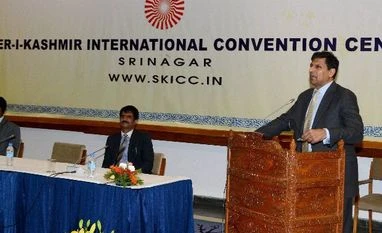 "Happy to let PDMA go to govt: Rajan")


 Connect with us on WhatsApp