Home / World News / N Korea a 'threat to the world': Kerry
N Korea a 'threat to the world': Kerry
He along with Chinese Foreign Minister said the two powers will work for an agreement on a UN resolution on the issue
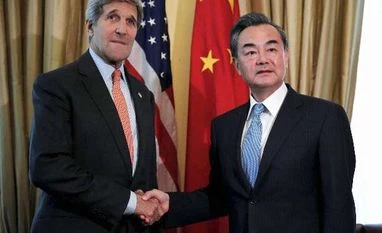
US Secretary of State John Kerry, left, shakes hands with Chinese Foreign Minister Wang Yi at a hotel where the Iran nuclear talks meetings are being held in Vienna, Austria. Photo: AP/PTI
Nuclear-armed North Korea poses an "overt threat, a declared threat to the world", US Secretary of State John Kerry said in Beijing today after talks with his Chinese counterpart following Pyongyang's fourth nuclear test earlier this month.
"The United States will do what is necessary to protect our country and our friends and allies in the world," Kerry added at a joint press conference with Chinese foreign minister Wang Yi.
A US official said earlier the issue would be at the top of Kerry's agenda in his talks with Wang, adding: "The Secretary has made no secret... Of his conviction that there is much more that China can do by way of applying leverage (on Pyongyang)."
China is North Korea's chief diplomatic protector and economic benefactor, but those ties have become strained in recent years as Beijing's patience wears thin with Pyongyang's unwillingness to rein in its nuclear weapons ambitions.
After the latest test on January 6 - which Pyongyang said was a miniaturised hydrogen bomb, a claim largely dismissed by experts - China said it "firmly opposes" the North's actions and summoned its diplomats for "solemn representations".
Nevertheless, the Asian power has proven reluctant to follow Washington's lead on the issue and no substantive actions towards the North have been announced.
Kerry said the two powers - both of them permanent members of the UN Security Council - had agreed to mount an "accelerated effort" to reach agreement on a new United Nations resolution on the issue.
But Beijing's ties with Pyongyang were forged in the blood of the Korean War and analysts say its leverage is mitigated by its overriding fear of a North Korean collapse and the prospect of a reunified, US-allied Korea directly on its border.
Earlier, as the two diplomats met, Wang welcomed the fact that Kerry's trip had taken in a number of Asian countries, saying visiting them could help him understand the continent. "It can help you listen to voices more objectively," he added.
As Kerry arrived in Beijing on Tuesday, the state-run China Daily ran an article headlined: "Experts have low hopes for Kerry's China trip."
Before today's meeting, the official news agency Xinhua issued a commentary blaming the US's "uncompromising hostility" and "Cold War mentality" for the situation on the Korean peninsula.
Washington's actions, such as flying a nuclear-capable B-52 bomber close to the inter-Korean boder, were heightening the North's "sense of insecurity and thus pushing it towards reckless nuclear brinkmanship", it added.

 "N Korea a 'threat to the world': Kerry")


 Connect with us on WhatsApp