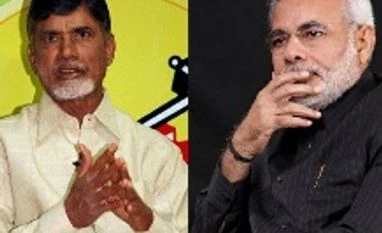
Naidu writes to Modi, supports gas price pooling
He supported the plan to average out the price of costly LNG with cheaper domestically produced gas so as to make feedstock affordable for power generation
Press Trust of India New Delhi With peak energy demand projected to double in three years, Andhra Pradesh Chief Minister N Chandrababu Naidu has asked Prime Minister Narendra Modi to expedite pooling of natural gas prices to make available affordable fuel to power plants.
Naidu last week wrote to Modi supporting the plan to pool or average out the price of costly imported gas (LNG) with cheaper domestically produced gas so as to make feedstock affordable for power generation.
Sources said the Chief Minister told Modi that Andhra Pradesh has 7,000 MW of stranded gas based electricity generation capacity, primarily due to stoppage of supply of gas from Reliance Industries' eastern offshore KG-D6 fields from April 1, 2013.
With KG-D6 output dwindling, the government had decided to restrict supply only to fertiliser plants manufacturing subsidised urea. As a result, supplies to power plants, who are ranked third on the priority list for receiving gas, were cut.
Fertiliser plants are top ranked for receipt of scarce domestically produced gas, followed by LPG manufacturing plants, power stations and city gas distribution firms selling CNG to automobiles.
Naidu said energy requirement in Andhra Pradesh is expected to jump from 43,684 million units to 82,392 million units in 2018-19, requiring a generation capacity of 13,436 MW as against 6,158 MW currently.
Sources said the Chief Minister told Modi that Andhra Pradesh government supports the Centre's initiative of a gas pooling mechanism wherein rates of domestic gas would be averaged out with costlier imported LNG to make more cheaper gas to power plants.
While majority of domestically produced gas currently costs $4.2 per million British thermal unit, imported liquefied natural gas (LNG) costs at least thrice that price.
Gas pooling, or averaging, would mean that plants currently getting cheaper domestic gas will have to pay a slightly more. On the other hand, stations with no domestic gas supplies that are necessarily to rely on imported fuel, will pay a lot less, thereby making electricity produced affordable.
Sources said Naidu requested the Prime Minister to expedite the process of gas pooling in the national interest and assured all cooperation.
He also requested that the state also be accorded the first priority in allocation of natural gas in future in view of the stranded capacities.
Power plants, which currently cannot buy high priced LNG because electricity thus generated will find no buyers, will be able to buy gas at pooled rate. This would enable the existing gas based plants to significantly improve their run-rate or operating capacity.

 "Naidu writes to Modi, supports gas price pooling")


 Connect with us on WhatsApp