NASA's InSight mission to study the deep interior of Mars is targeting a new launch window that begins May 5 2018, with a landing scheduled for November 26 that year.
The spacecraft had been on track to launch this month until a vacuum leak in its prime science instrument prompted NASA to suspend preparations for launch.
InSight's (Interior Exploration using Seismic Investigations, Geodesy and Heat Transport) will help study how rocky planets - including Earth - formed and evolved.
InSight project managers proposed a plan to redesign the science instrument was accepted in support of a 2018 launch.
"The quest to understand the interior of Mars has been a longstanding goal of planetary scientists for decades. We're excited to be back on the path for a launch, now in 2018," said John Grunsfeld, associate administrator for NASA's Science Mission Directorate in Washington.
NASA's Jet Propulsion Laboratory (JPL) will redesign, build and conduct qualifications of the new vacuum enclosure for the Seismic Experiment for Interior Structure (SEIS), the component that failed in December.
France's space agency, Centre National d'Etudes Spatiales (CNES) will lead instrument level integration and test activities.
The two agencies have worked closely together to establish a project schedule that accommodates these plans, and scheduled interim reviews over the next six months to assess technical progress and continued feasibility, NASA said.
The seismometer instrument's main sensors need to operate within a vacuum chamber to provide the exquisite sensitivity needed for measuring ground movements as small as half the radius of a hydrogen atom.
The rework of the seismometre's vacuum container will result in a finished, thoroughly tested instrument in 2017 that will maintain a high degree of vacuum around the sensors through rigours of launch, landing, deployment and a two-year prime mission on the surface of Mars.
The lander's Heat Flow and Physical Properties Package probe will hammer itself to a depth of about 16 feet into the ground beside the lander.
SEIS was built with the participation of the Institut de Physique du Globe de Paris and the Swiss Federal Institute of Technology, the Max Planck Institute for Solar System Research, Imperial College London, and JPL.
NASA is on an ambitious journey to Mars that includes sending humans to the Red Planet, and that work remains on track.
Robotic spacecraft are leading the way for NASA's Mars Exploration Programme, with the upcoming Mars 2020 rover being designed and built, the Opportunity and Curiosity rovers exploring the Martian surface, the Odyssey and Mars Reconnaissance Orbiter spacecraft currently orbiting the planet, along with the Mars Atmosphere and Volatile Evolution Mission (MAVEN) orbiter, which is helping scientists understand what happened to the Martian atmosphere.

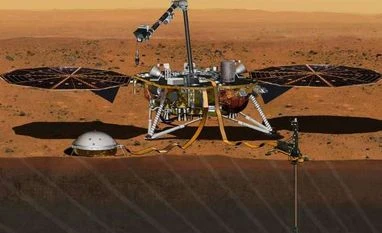 "NASA's new Mars mission set to be launched in May 2018")


 Connect with us on WhatsApp