
Paris summit: Obama played African-American card to win Modi, claims book
India was the last holdout as its officials were the toughest negotiators, says the book, The World as It Is: A Memoir of the Obama White House
 "Paris summit: Obama played African-American card to win Modi, claims book")
WebinarsNew
Deep DiveNew
Explore Business Standard
India was the last holdout as its officials were the toughest negotiators, says the book, The World as It Is: A Memoir of the Obama White House
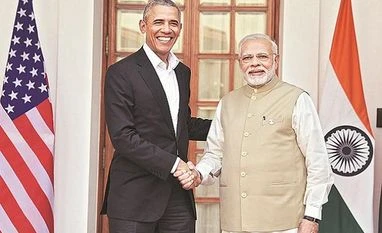
The then US President Barack Obama used his African-American card to win over Prime Minister Narendra Modi during the last phase of negotiations at the Paris summit in late 2015, where India was the last holdout as its officials were the toughest negotiators, says a book on his presidency.
"When we got to Paris, the main holdout was India," Obama's then top foreign policy and national security aide for eight years Ben Rhodes writes in his book 'The World as It Is: A Memoir of the Obama White House'.
The book will hit stands today.
Rhodes was Obama's Deputy National Security Advisor for Strategic Communications.
Giving a blob-by-blow account of the last phase of US-India talks on climate change, Rhodes writes that at one point of time in Paris Obama himself entered into a personal conversation with two Indian officials to convince them of the need for India to be part of the deal. But he failed to cut ice with the two Indian negotiators, says the book.
Then he spend nearly an hour with Modi in Paris. Nothing appeared to work till the time Obama played the African-American card, according to the book.
For nearly an hour, Modi kept underscoring the fact that he had three hundred million people with no electricity, and coal was the cheapest way to grow the Indian economy; he cared about the environment, but he had to worry about a lot of people mired in poverty. Obama went through arguments about a solar initiative we were building, the market shifts that would lower the price of clean energy," writes Rhodes in his book.
"But he still hadn't addressed a lingering sense of unfairness, the fact that nations like the United States had developed with coal, and were now demanding that India avoid doing the same thing. 'Look', Obama finally said, 'I get that it's unfair. I'm African-American'. Modi smiled knowingly and looked down at his hands. He looked genuinely pained," he writes.
"I know what it's like to be in a system that's unfair," he went on. "I know what it's like to start behind and to be asked to do more, to act like the injustice didn't happen. But I can't let that shape my choices, and neither should you. I'd never heard him talk to another leader in quite that way. Modi seemed to appreciate it. He looked up and nodded," writes the former top White House official, while describing how Obama used his African-American card to convince Modi.
But before it, Rhodes writes, Obama tried and could not succeed in convincing the Indian negotiators.
"We were scheduled to meet with India's prime minister, Narendra Modi. Obama and a group of us waited outside the meeting room, when the Indian delegation showed up in advance of Modi. By all accounts, the Indian negotiators had been the most difficult," he writes.
"Obama asked to talk to them, and for the next twenty minutes, he stood in a hallway having an animated argument with two Indian men. I stood off to the side, glancing at my BlackBerry, while he went on about solar power," says Rhodes. This was something unprecedented and not part of the protocol. he adds.
"One guy from our climate team came over to me. 'I can't believe he's doing this,' he whispered. 'These guys are impossible'. 'Are you kidding?' I said. 'It's an argument about science. He loves this'. Modi came around the corner with a look of concern on his face, wondering what his negotiators were arguing with Obama about," writes Rhodes.
"We moved into the meeting room, and a dynamic became clear. Modi's team, which represented the institutional perspective of the Indian government, did not want to do what is necessary to reach an agreement," he says.
"Modi, who had ambitions to be a transformative leader of India, and a person of global stature, was torn. This is one reason why we had done the deal with China; if India was alone, it was going to be hard for Modi to stay out," Rhodes writes in the book.
(Only the headline and picture of this report may have been reworked by the Business Standard staff; the rest of the content is auto-generated from a syndicated feed.)
First Published: Jun 06 2018 | 8:16 AM IST

