Home / World News / Perils on path to power for Myanmar's Aung San Suu Kyi: Political analysts
Perils on path to power for Myanmar's Aung San Suu Kyi: Political analysts
Suu Kyi was locked up for 15 years by paranoid generals fearful of the democracy campaigner's enormous popularity
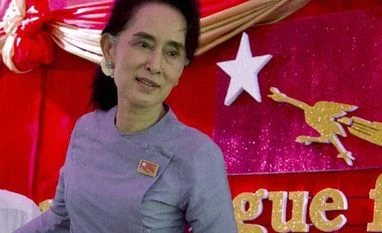
Myanmar's opposition leader Aung San Suu Kyi leaves a press conference at her home in Yangon. On Sunday Myanmar will hold what is being viewed as the country's best chance for a free and credible election. Photo: AP/PTI
Wielding an overwhelming mandate from Myanmar's voters, Aung San Suu Kyi has power in her sights after a quarter century of democratic struggle against the army, but analysts say building bridges with former military foes is vital to her success.
A resounding victory for Suu Kyi and her National League for Democracy (NLD) sets the stage for a radical rebalancing of power in Myanmar, dominated for generations by repressive and economically-ruinous military rule.
In a sign of the deep craving for change in the nation, voters handed the party 80 per cent of elected seats in the national legislature.
The result sends a "strong signal to the military that the writing is on the wall and your domination is coming to an end", said political analyst Khin Zaw Win.
Suu Kyi was locked up for 15 years by paranoid generals fearful of the democracy campaigner's enormous popularity.
But to rule she will have to foster a relationship with the country's military elites, who continue to hold significant political and economic power despite reforms under a quasi-civilian regime that replaced junta rule in 2011.
Observers predict tremulous times ahead for the Nobel laureate, with some four months before an NLD led government can take the reins under Myanmar's complex political system.
Burned into public memory is the bitter disappointment of 1990 elections, which were won overwhelmingly by the NLD only to be ignored by the military, who clung to power for another two decades.
So far the signs are positive, according to Khin Zaw Win who said the NLD had a "once in a century" chance to steer Myanmar towards a brighter future.
Suu Kyi, 70, has taken a conciliatory approach, declining to make a victory speech and seeking talks with President Thein Sein and army chief Min Aung Hlaing, due to go ahead in the coming days.
The army have sought to reassure Myanmar's nervous citizens, indicating a willingness to work with their erstwhile arch foes in the NLD, who will flood into the capital Napyidaw in February when a new parliament session opens.
Suu Kyi cannot take the post under the charter because she married and had children with a foreigner.
The Nobel laureate has pledged to circumvent this by ruling "above the president", a legally uncertain position that has not been fully explained and might echo the role of India's Italian-born Sonia Gandhi. But it could put her on a collision course with the army.
Once the rice bowl of Asia, where it has a pivotal location between China and India, Myanmar was brought to its knees by isolation, sanctions and disastrous economic management under half a century of military rule.

 "Perils on path to power for Myanmar's Aung San Suu Kyi: Political analysts")


 Connect with us on WhatsApp