
Punjab records 74,000 instances of stubble burning, maximum in 4 years
Experts said anger over farm bills and the government not paying the Supreme Court-ordered financial incentive to farmers could be among the reasons for the spike in farm fires
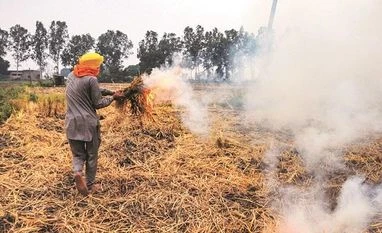 "Punjab records 74,000 instances of stubble burning, maximum in 4 years")
WebinarsNew
Deep DiveNew
Explore Business Standard
Experts said anger over farm bills and the government not paying the Supreme Court-ordered financial incentive to farmers could be among the reasons for the spike in farm fires
Punjab has recorded around 74,000 incidents of stubble burning this season, the maximum in four years, with experts saying anger over farm bills and the government not paying the Supreme Court-ordered financial incentive to farmers could be among the reasons for the spike in farm fires.
According to data released by the Punjab Remote Sensing Centre, the state recorded 73,883 incidents of stubble burning between September 21 and November 14, which is the highest since 2016.
Punjab had reported 51,048 cases of stubble burning in the corresponding period last year and 46,559 such incidents in 2018. The number of farm fires was 43,149 in the state during the same period in 2017.
An official from the Indian Agricultural Research Institute (IARI) said the incidents of stubble burning hit the peak between November 4 and November 7.
According to the Ministry of Earth Sciences' air quality monitor, SAFAR, the share of stubble burning in Delhi-NCR's pollution peaked to 42 per cent on November 5, when 4,135 farm fires were recorded in the region.
"It was a bumper harvest this year, so the amount of crop residue was also large. Also, it was a cloud-free season as compared to last year. The biomass was drier and prone to burning.
"It also appears that the farmers are not willing to cooperate. There could be anger over farm bills," he said.
According to a Punjab government official, "farmers are not happy" as the ruling dispensation has not disbursed the financial incentive to them as directed by the Supreme Court to prevent stubble burning.
Following the apex court's guidelines to incentivise farmers to stop stubble burning, the governments of Punjab and Haryana announced a bonus of Rs 2,500 per acre for small and marginal farmers last year. Farmers say the incentive can help them cover the cost of fuel used in operating machinery for in-situ management of stubble.
Harinder Singh Lakhowal, the general secretary of the Bharatiya Kisan Union, Punjab, also said the number of farm fires is "very high this year and anger over farm bills is one of the major reasons".
"Unavailability of labourers -- many returned to their native states due to the COVID-19 pandemic -- is also a reason why farmers are burning stubble to clear the fields quickly," he added.
The IARI official said the increase in the number of incidents of stubble burning does not mean that the policy of providing farm equipment for in-situ management of crop residue has failed.
"The numbers of stubble burning incidents in Haryana and Uttar Pradesh tell a different story altogether. The figures have come down significantly," he said.
According to IARI's data, Haryana recorded 4,699 farm fires between October 1 and November 12 while Uttar Pradesh reported 2,288 such incidents during the period, which is the lowest in both the states in the last five years.
Haryana recorded 5,807 incidents of stubble burning and Uttar Pradesh 2,653 cases during the corresponding period last year.
"In Punjab also, the number of cases was reducing every year till 2019. Only 2020 has been the 'odd' year out," the IARI official said.
According to a study conducted by IARI scientists in Tarn Taran and Amritsar districts of Punjab, stubble burning incidents between October 1 and October 10 in Amritsar increased from 180 in 2019 to 515 in 2020 -- a rise of about 2.9 times.
In Tarn Taran, the number of stubble burning incidents increased from 92 in 2019 to 341 in 2020 -- a rise of about 3.7 times.
"It is estimated that the harvested area increased by 35,500 hectares in Amritsar and by 39,300 hectares in Tarn Taran by October 10 this year as compared to last year.
"It indicates a significant early harvesting of paddy in these two districts this year, which may be on account of early planting of paddy by about 7-10 days, an increase in the proportion of area under short-duration varieties, and a clear weather during 2020 as compared to a cloudy weather in 2019 during the same period," the study said.
"By October 10, the proportion of burnt area to harvested area in Amritsar increased from 38 per cent in 2019 to 74.6 per cent in 2020. In Tarn Taran, it increased from 30.9 per cent in 2019 to 60.9 per cent in 2020," it added.
Punjab, Haryana and Uttar Pradesh attract attention during the paddy harvesting season between October 15 and November 15.
Farmers set their fields on fire to quickly clear off the crop residue left behind after harvesting paddy and before cultivating wheat and potato. It is one of the main reasons for the alarming spike in pollution in Delhi-NCR.
Last year, Punjab produced around two crore tonnes of paddy residue, of which 98 lakh tonnes were burnt by farmers.
Farmers in Haryana burnt 12.3 lakh tonnes of the 70 lakh tonnes of paddy residue produced.
Despite a ban on stubble burning in Punjab and Haryana, farmers continue to defy it as there is a short window between the harvesting of paddy and the sowing of wheat.
The high cost of manual or mechanical management of straw is a major reason why farmers choose to burn it.
State governments are providing a 50 to 80-per cent subsidy to farmers and cooperative societies to buy modern farm equipment for in-situ management of paddy straw, installing paddy straw-based power plants and running a massive awareness campaign against stubble burning.
(Only the headline and picture of this report may have been reworked by the Business Standard staff; the rest of the content is auto-generated from a syndicated feed.)
First Published: Nov 15 2020 | 3:26 PM IST

