
BRICS aim to finish development bank preparations by July summit
The bank, first proposed in 2012, has been slow in coming, with prolonged disagreements over various issues
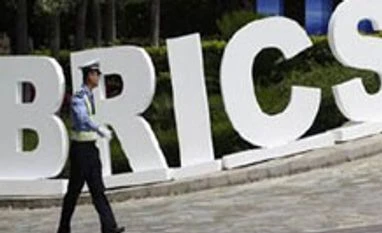 "BRICS aim to finish development bank preparations by July summit")
WebinarsNew
Deep DiveNew
Explore Business Standard
The bank, first proposed in 2012, has been slow in coming, with prolonged disagreements over various issues
The bank Brazil, Russia, India, China and South Africa plan to support infrastructure projects has been slow in coming, with prolonged disagreements over its funding, management and headquarters.
The group, which has struggled to take coordinated action on most issues in the past year after the scaling back of US stimulus prompted an exodus of capital from their markets, is hoping their leaders will officially launch the bank at their July meeting in Brazil.
"We've made very good progress on the new development bank and most of the formal documentation is ready," Gordhan told journalists after a meeting of the BRICS finance ministers in Washington.
"There will be a few issues left, which will be resolved between now and the middle of July when we hope the summit will take place."
The start-up capital of $50 billion would eventually be built up to $100 billion. Russia has proposed that each member contributes an equal, 20% share, but the share distribution is still to be decided, a BRICS source said.
The bank was first proposed in 2012. The proposal was approved last year at a BRICS summit in South Africa. The group's other project, a $100 billion fund designated to steady currency markets, has also been off to a slow start, but Gordhan said progress has been made on that project, as well.
"On the contingency reserve arrangements, we're also almost 90% of the way towards agreement. Formal documents are ready and we have the basis to reach 100% agreement before the summit."
CONCERNS OVER STALLED IMF REFORMS
The BRICS are also concerned that the US Congress has failed to ratify reforms to the International Monetary Fund that would double the Fund's resources and give more say to emerging markets, such as the BRICS.
"We've discussed our mutual concerns about the slow pace of the IMF reforms and the kind of stalemate that we find ourselves in currently and we hope work with everyone to find an equitable solution," Gordhan said.
"But clearly a lot depends on the US"
Some officials from the Group of 20 advanced and emerging economies have suggested moving ahead on the reforms without the United States, although US approval would be necessary for any major decision to go forward because of Washington's controlling share of IMF votes.
Gordhan declined to comment on what could be done, saying only that "there are a number of options being explored" that need further "cooking."
"We believe it's in the collective interest of all us to have a strong and well-resourced IMF but also an IMF that is increasingly even-handed in the way it approaches both advanced economies and emerging markets as well," he said.
First Published: Apr 11 2014 | 4:39 AM IST


 Connect with us on WhatsApp