The Soviet Union had the most arduous of domestic championships. Players placing high in sundry “national” championships (of Georgia, Latvia, Russia, Armenia, et cetera) played semi-finals. Qualifiers from the semis played a 20-player round robin, with several world champions. Anybody who made the final league was at the least, a credible Candidate.
India had a similarly arduous championship, though the field was much weaker. Hopefuls played state championships and then a semi-final, the “National B”. The top 14 from the B qualified for the championship proper (alias the “National A”). The A was a round-robin featuring 20 players with the top six seeded for the next A.
Neither national championship carried much direct financial reward. Soviets were “amateurs” who lived off stipends and sinecures arranged by the federation. Indians hoped to be absorbed into sports quota jobs, preferably in a nationalised bank or a PSU. The big deal was that the top six represented India abroad in international events, including zonals and Olympiads. In theory, this was also the case with the Soviets but of course, politics often led to top Soviet players being replaced.
Times have changed and, while the prestige of the Russian Super-Final is high, it is not the same as the old USSR finals. In India, too, many top players prefer to skip the cycle. One key difference is that any Indian player rated above 2650 has a direct entry to the final (which is now called the Premier) — and there are six Indians currently in that exalted group.
The B is now the National Challengers and it remains a nerve-racking event. It is a Swiss with a huge mixed field, comprising both unrated players and high-rated GMs. This means the high-rated players are on a hiding to nothing in that they can make a great score and still lose Elo.
Last year, the Challengers was unrated in order to encourage high-rated players to play. It didn’t work. This year, the Challengers will be rated but participants must be rated at above Elo 2199. This could encourage high-rated players to have a go. But it is unfair to the young hopeful who cracks a state championship while being low-rated or unrated. For many Indians from smaller states with no chess culture, the Challenger is still the only chance for a breakthrough.
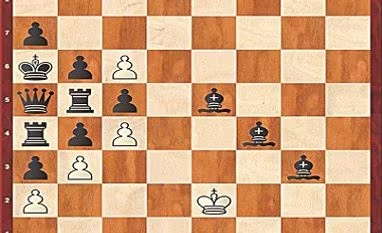
The diagram, WHITE TO PLAY AND DRAW/ WIN, is composed by Sir Roger Penrose. It’s very hard to understand for engines. Penrose hopes to scan the brains of humans who “solve” this quickly, to develop some insight into intuition. White draws by refusing captures and just moving the king around. He may win if K travels to a8 and black takes three (!) bishops to say, f6,g5,h4 allowing c8=Q checkmate.
Devangshu Datta is an internationally rated chess and correspondence chess player

 "CHESS#1243")












 Connect with us on WhatsApp