G20's declining share in the world, amid India's growing influence

As the country prepares to host the summit of twenty nations next year in September 2023, it also has to tackle rising concerns of climate change and calls for the expansion of the group from other co

India, G20 presidency, PM Modi, Indonesia
India will assume the G20 presidency on Thursday
Ishaan GeraAnoushka SawhneySamreen Wani New Delhi
3 min read Last Updated : Nov 30 2022 | 10:40 PM IST
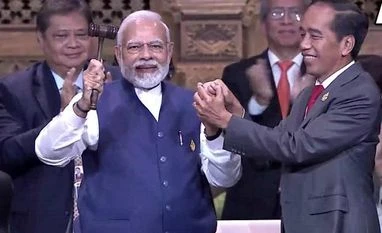
On Thursday, India will assume the G20 presidency. As the country prepares to host the summit of 20 nations in September 2023, it also has to tackle rising concerns of climate change and calls from other countries for the expansion of the group.

In 1999, when the Group of 20 or G20 was formed, the countries accounted for 87.6 per cent of the global output. In 2021, data from World Bank shows, their share declined to 85.6 per cent (chart 1). Similarly, in merchandise trade, the share of G20 countries declined from 80.2 to 76.5 per cent.

However, analysis shows a shift within G20 players as well. The Group of Seven or G7 countries’ share in global output and trade has fallen faster than that of the other G20 nations. The share of G7 in global output declined from 67.5 per cent in 1999 to 51 per cent in 2021. In trade, the share declined from 65.9 to 47.7 per cent during the same period (chart 2).

The G20 countries also account for a relatively smaller share of the global population compared to 1999. Despite boasting two of the most populous countries in the world, its share has declined from 66.5 per cent in 1999 to 61.6 per cent in 2021 (chart 3).

 But the decline in population has also come on the back of a rise in life expectancy and better health outcomes. The life expectancy in G20 economies in 2020 was 77.6 years, compared to the global average of 72.7. It was still lower than the G7 average of 81.3 years (chart 4).

As the clamour for climate action grows louder, these economies would have to reorient to incorporate climate as a significant agenda. Analysis of data from the Global Carbon Project 2022 shows that the countries accounted for 80 per cent of the world’s carbon emissions (chart 5). 

While G20’s global influence may be declining, India has witnessed an improvement in its standing within the group. India accounted for 1.91 per cent share of the G20’s total output at the time of the group’s formation. In 2021, India’s share rose to 3.68 per cent (chart 6).


One subscription. Two world-class reads.

Already subscribed? Log in

Subscribe to read the full story →
*Subscribe to Business Standard digital and get complimentary access to The New York Times

Smart Quarterly

₹900

3 Months

₹300/Month

SAVE 25%

Smart Essential

₹2,700

1 Year

₹225/Month

SAVE 46%
*Complimentary New York Times access for the 2nd year will be given after 12 months

Super Saver

₹3,900

2 Years

₹162/Month

Subscribe

Renews automatically, cancel anytime

Here’s what’s included in our digital subscription plans

Exclusive premium stories online

  • Over 30 premium stories daily, handpicked by our editors

Complimentary Access to The New York Times

  • News, Games, Cooking, Audio, Wirecutter & The Athletic

Business Standard Epaper

  • Digital replica of our daily newspaper — with options to read, save, and share

Curated Newsletters

  • Insights on markets, finance, politics, tech, and more delivered to your inbox

Market Analysis & Investment Insights

  • In-depth market analysis & insights with access to The Smart Investor

Archives

  • Repository of articles and publications dating back to 1997

Ad-free Reading

  • Uninterrupted reading experience with no advertisements

Seamless Access Across All Devices

  • Access Business Standard across devices — mobile, tablet, or PC, via web or app

Topics :G20 G20 nationsIndian EconomyG20 meetingG20 economiesG20 meetsG20 summitG20 MeetWorld Bank GroupWorld Bank

Next Story