If you want to take a top-end flat in Gurgaon on rent, this is the time to do it. Rents have softened 10-20 per cent in the last one year across properties. Conversely, if you have invested in one of these flats, you may want to curse yourself because the returns have nosedived in the past year. While capital appreciation has become almost zero, rental income has fallen to 2 per cent and below of capital value. At DLF Aralias, where a bare-shell flat can cost Rs 12-14 crore, the rent has fallen to just Rs 2 lakh per month. Factor in inflation of 9.5 per cent, and your returns move significantly into the negative territory. You would have been wiser to put your money in the stock market (18.85 per cent return in the last one year) or even a fixed deposit in a bank that would have fetched you 8.5 per cent income.
The primary reason for the fall in rents is the mismatch between demand and supply. With the Delhi suburb emerging as a hub for companies, Indian as well as multinational, real estate developers had invested heavily in top-end apartments. Given the high cost of land (and the substantial speed money), affordable and mid-income homes did not make much sense for the developers. Most of them thus started to focus on the luxury end of the market. According to estimates, there are in Gurgaon over 2,000 flats that cost Rs 15,000 per square feet and above, and another 1,000 are under construction. But the economic slowdown of the last few years has played havoc with rents.
Most of these flats are hired by companies. With the slowdown, many companies decided to curb the perks given to senior executives — they had no option but to settle for lesser houses. The market began to crack. Meanwhile, many of the luxury flats were bought by investors; for them, it was financially disastrous to let the flats remain unoccupied. They responded by dropping rents. Ernesto Cohnen, vice-president (products) of ixigo, a travel portal, says at DLF Belaire, where he is a tenant, rents have fallen to Rs 60,000-Rs 100,000 (maintenance is extra) for flats that measure 2,858 to 4,098 square feet. In spite of such low rents, Cohnen says many flats remain unoccupied.
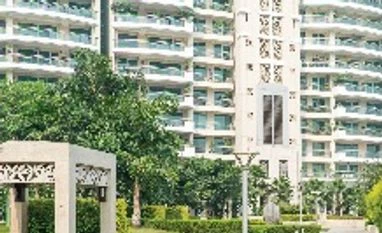
Front view of DLF Aralia
Did the builders misread the market? Akash Ohri, executive director (business development), DLF Home Developers, insists that the demand for super-luxury homes remains strong because this “sector caters mostly to high net-worth individuals who have grown at a faster pace in the last five years and non-resident Indians, or NRIs, who are looking to invest in lucrative properties back home”. According to Ohri, the depreciation of the rupee vis-à-vis major currencies of the West has made India an attractive investment destination for NRIs. The recent strengthening of the rupee could take some shine off the market. Some brokers, on the other hand, say that finding tenants for top-end flats has become difficult. “Most people in Gurgaon need 3BHK flats that are 1,600 to 2,000 square feet in size,” says Sanjay Singh of Optima Realtors. “The demand for 5,000-square-feet flats isn’t all that strong, yet developers keep introducing such projects.”
For those who bought these flats earlier, the capital appreciation has been significant. Anil Sachdev, the founder of School of Inspired Leadership, had bought an apartment at DLF Aralias at Rs 4,750 per square foot in 2006; the current price is Rs 22,000 per square foot. Sachdeva’s investment has grown over four times in eight years. Naturally, he is quite happy with the appreciation. “My neighbours, some of whom are old friends, are also quite happy with their investment,” says he. Rents, he argues, are low because the (well-off) owners give out their flats only to ensure that it is looked after and helps them take care of overheads like property tax.
The outlook for rents remains muted. Nobody is sure when corporate earnings will improve and how much time will it take for the inventory to clear. Rohan Sharma, senior manager (research), Jones Lang LaSalle, says prices have more or less stabilised now after a “necessary” correction and should not decrease further. Some developers fear that the Delhi government’s new farmhouse policy could dampen the demand for top-end flats in the days to come. According to the new policy, farmhouses can be built on 1 acre of land (down from 2.5 acres) and up to three dwelling units can be built on each plot.
As a result, these farmhouses, especially in areas like Rajokri and Westend Greens that are close to Gurgaon, will cost around the same as top-end flats. Some people may choose to shift to these farmhouses. Incidentally, the Haryana government too has come out with a farmhouse policy, which allows for developing farmhouses in 100 acres and above. Since the cost of that much land in Gurgaon will be prohibitively expensive, that policy is expected to remain a non-started, at least in Gurgaon.
Slowly, luxury homes may have turned from an owner’s market to a tenant’s market.

 "The rent crash")


 Connect with us on WhatsApp